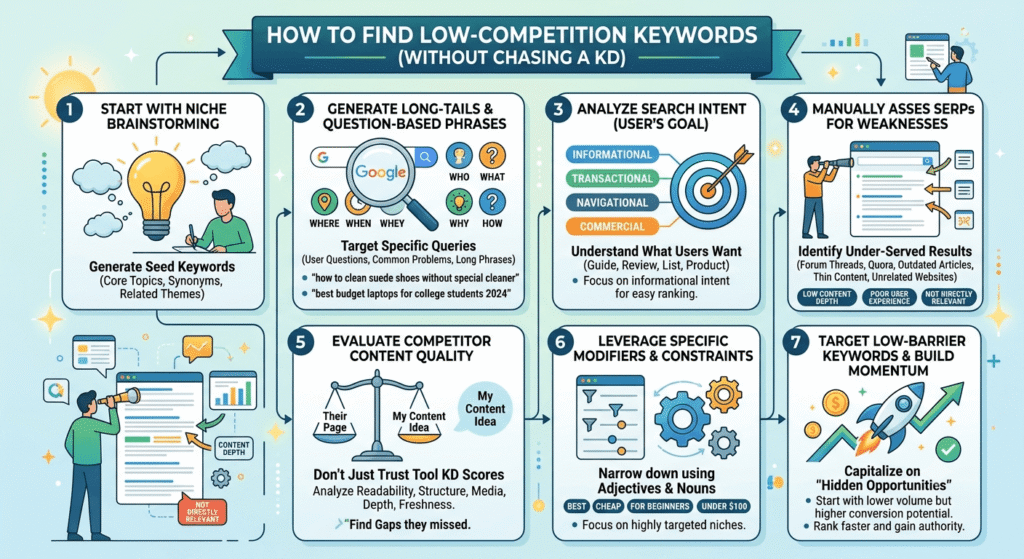
Summary:
- Keyword difficulty scores are a filter, not a strategy. Most guides on this exact topic stop at “sort by KD” and call it a method.
- Comparison and competitor-brand terms are consistently easier to rank than generic feature keywords, and they convert better because the searcher already knows what they want.
- An Indian accounting software client went from 770 to 1,650 monthly organic clicks in 8 months, and the average position moved from roughly the low-40s to the mid-teens by targeting comparison terms against Tally, Zoho, Xero, and Vyapar before touching a single head term.
- AI search platforms are already citing forum threads for this exact query. That’s a content gap most people writing about keyword research haven’t noticed.
- A low-volume keyword only earns your time if it feeds a clear next step. “Easy to rank” and “worth ranking for” are two different questions.
Low-competition keywords are search terms with real demand but weak or absent coverage from authority sites. The fastest way to find them isn’t to open a keyword tool and sort by difficulty score. It’s targeting competitor-brand and comparison terms your rivals haven’t claimed yet.
I used this exact approach with an Indian SaaS client in the accounting software space. Zero to page-one visibility wasn’t the story here; they had some traffic already, but targeting comparison terms against established players like Tally, Zoho, Xero, and Vyapar took them from 770 to 1,650 monthly organic clicks over 8 months, with average position climbing from roughly the low-40s to the mid-teens over the same window.
That’s the method this post walks through. Not another “sort by KD and hope” guide.
What Actually Counts as Low Competition in 2026
Here’s the irony you’re standing in right now. “How to find low competition keywords” is itself a moderately competitive term. Semrush’s own blog ranks for it. So does Ahrefs-adjacent content, a 13-year-old established blogger, and half a dozen Medium and LinkedIn reposts of the same “I used to chase big keywords, now I don’t” story.
If you typed this exact phrase into a KD checker, you’d get a difficulty score that undersells the real fight, because domain authority and content depth matter more than the tool’s raw number lets on.
That’s the first thing to unlearn: A keyword difficulty score is an estimate of average competition, not a guarantee for your specific site. A KD of 25 means nothing if the top 3 results are all from sites with domain ratings ten times yours and you have zero backlinks pointing at the page. It also means less than you’d think if the ranking pages are thin, outdated, or answering the wrong intent.
Low competition, in practice, means: searches where the gap between what’s ranking and what a searcher actually needs is wide enough for a well-built page to slot in. Sometimes that’s a low KD score. Sometimes it’s a keyword tool skips entirely.
The KD Score Method (Table Stakes, Not a Strategy)
You already know this part, or you’ve read a version of it a dozen times. Quick version so this post doesn’t pretend it doesn’t exist:
- Drop a seed term into a keyword tool. Ahrefs, Semrush, Ubersuggest, Google Keyword Planner, whatever you’ve got access to.
- Pull up Keyword Ideas or Matching Terms.
- Sort by Keyword Difficulty, low to high.
- Cross-check search volume so you’re not chasing a term with 10 monthly searches and no realistic payoff.
- Check who’s actually ranking. If the lowest-ranking page in the top 10 has a domain rating lower than the tool’s KD score suggests, that’s a signal the term is easier than the score implies.
This works. It’s also exactly what every other guide on this topic already tells you, which is why it alone won’t get you cited anywhere or differentiate your content strategy. Use it as your first filter, not your whole plan.
The Comparison-Keyword Method (This Is the Part That Actually Moves the Needle)
Here’s what the KD-score crowd consistently misses: terms built around a competitor’s brand name are almost always lower competition than generic feature terms, and the person searching them is closer to a decision.
Someone typing “[your competitor] alternative” or “[competitor A] vs [competitor B]” already knows the category. They’re evaluating, not learning. That’s a searcher worth writing for.
This is what worked for the accounting software client. Instead of fighting for “accounting software for small business” (a term every established player already owns), the content plan targeted terms like:
- “[Product] vs Tally”
- “[Product] vs Zoho Books”
- “Xero alternative for [specific use case]”
- “Vyapar alternative with [specific feature]”
None of these show up as headline volume in a keyword tool. All of them pull searchers who are one comparison page away from a trial signup. 8 months in, clicks moved from 770 to 1,650, and average position climbed from the low-40s into the mid-teens.
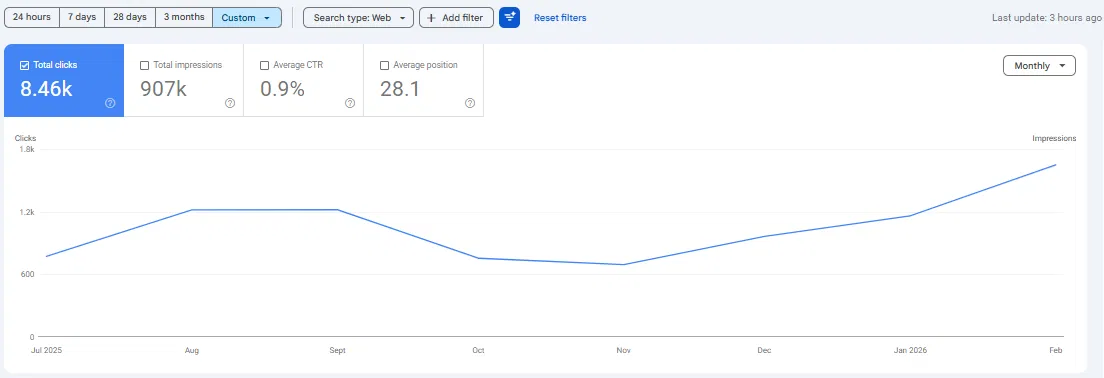
- GSC Image
Worth flagging, honestly: growth wasn’t a straight line. There was a real dip around October and November, caused by a server connectivity issue that returned 5XX errors and led to several pages being temporarily deindexed. Recovery came once the hosting issue was fixed and Google recrawled the site. If you’re running this same play, build in monitoring for exactly this kind of technical failure. A great content strategy still fails if your server goes down and Google can’t reach the page.
To find these terms yourself:
- List every real competitor and alternative your audience considers, not just the obvious market leader.
- Run “[competitor] alternative,” “[competitor] vs [your category],” and “[competitor] pricing” through a keyword tool.
- Check search volume even at 10-50 monthly searches. These terms rarely show big numbers, but they convert disproportionately well because intent is so specific.
- Prioritize based on how close the searcher is to a decision, not on raw traffic potential.
Free Methods: Autocomplete, PAA, and Related Searches
If you’re not paying for a keyword tool yet, Google gives you this for free.
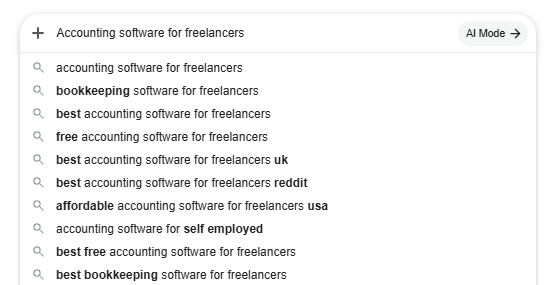
Google Autocomplete: Type your topic and stop halfway. “Accounting software for freelancers.” Google finishes your sentence with what real people are actually typing.
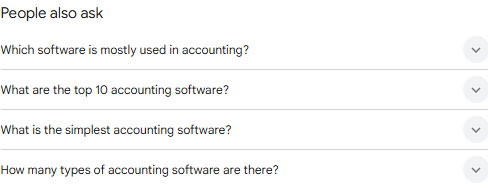
People Also Ask: Every question in that box is a real search someone ran. Scroll through it, click a few entries to expand more, and you’ll get a running list of sub-questions worth their own section or post.
Related searches: Scroll to the bottom of any results page. Google is handing you its own list of adjacent low-competition terms.
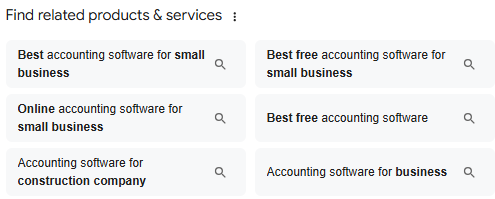
None of this is new: It’s the same advice you’ll find on Zapier’s blog and in a couple of Medium posts covering this exact topic. It works; it’s just not where your time is best spent once you’ve got the comparison-term method running.
The Gap Nobody’s Writing About: AI Search Is Already Answering This
Here’s the part missing from every piece currently ranking for this term. Ask ChatGPT or Perplexity “how do I find low competition keywords” and there’s a real chance the answer cites a Reddit thread or a Quora answer directly, not a polished blog post.
That’s not a threat. It’s a gap.
AI search platforms are pulling from forum-style, first-person answers because that’s what’s structured for extraction: a direct question, a direct answer, often in the first few sentences. Most SEO blogs bury the actual answer three paragraphs into a story about how the author “used to chase big keywords.”
If you want your content to show up when someone asks an AI assistant this question instead of typing it into Google, structure your answer the way this post does: a direct definition up top, a clear method, and an FAQ block that mirrors how people actually phrase the question out loud. That’s a genuinely different task than writing for a Google snippet, and almost nobody targeting this keyword is doing it on purpose.
A Decision Framework: When a Low-Volume Keyword Is Worth Your Time
Not every low-competition term deserves a page. Before you write one, run it through three questions:
- Does this match real reader intent, or does it just look easy on a spreadsheet? A keyword with zero competition and zero relevance to what you sell is a dead end.
- Does it feed a next step? In the accounting software example, comparison terms fed directly into trial signups. A low-competition term that dead-ends with no path to a conversion is a vanity metric.
- Can you actually write something better than what’s currently ranking, or would you just be adding one more thin page to a pile of thin pages?
If the answer to all three is yes, target it. If it’s a maybe on any of them, it goes on a list, not into your content calendar this month.
FAQ
Is keyword difficulty score accurate?
It’s a useful estimate, not a guarantee. KD scores are based on average competitor strength across ranking sites, but they don’t account for your specific domain authority, backlink profile, or content depth. A low KD score on a term still dominated by high-authority sites can be harder to rank for than the number suggests.
How do I find keywords with zero competition?
Look at comparison and competitor-brand terms first (“[competitor] alternative,” “[competitor A] vs [competitor B]”). These rarely show up with high volume in keyword tools, but they’re consistently underserved because most content strategies instead chase generic feature terms.
Can I rank a new website for competitive keywords?
Not directly, and not fast. Build authority through low-competition, high-intent terms first. As Google builds trust in your site, ranking for more competitive terms becomes realistic. Trying to compete for a head term with no domain history behind you is the fastest way to burn months with nothing to show for it.
What are low-competition, high-volume keywords?
They exist, but they’re rare and usually temporary. Once a term like this gets noticed, competition typically increases fast. Comparison and long-tail terms are a more reliable, repeatable source of low-competition opportunity than hunting for the rare high-volume, low-competition unicorn.
Do AI search tools use different keywords than Google?
Not exactly different keywords, but different content structures get cited. AI assistants tend to pull from content that provides a direct answer near the top and a clear FAQ structure, which is why some forum threads outrank polished blog posts in AI-generated answers, even without traditional Google authority.

Mansoor Bhanpurawala is the founder of DigitalMansoor.com. With 20K+ followers on LinkedIn, he has been doing SEO since 2012 and, with over 14 years of experience, has helped 600+ clients across multiple industries build sustainable online growth.
With consulting, he enjoys sharing beginner-friendly guides to help others start and scale their blogs and brands. He’s grown client traffic up to 50X and revenue up to 240X. Helped multiple clients get mentions on TOI, Forbes, Mint, etc.



Leave a Comment