Summary:
- SEO ranks pages. AEO wins extractable answers. GEO earns citations inside AI-generated responses. AIO gets used two different ways depending on who’s talking, and most people never say which one they mean.
- These aren’t four competing systems. AEO and GEO both need SEO fundamentals in place first, or there’s nothing for them to build on.
- Google’s own documentation, published in May 2026, states plainly that AEO and GEO aren’t separate disciplines for Google Search. They’re SEO. That single sentence undercuts a chunk of the content already published on this topic.
- If your site has low domain authority, ranking page one for a competitive term is a multi-year project. Getting cited by ChatGPT or Perplexity on a specific, narrow question is often reachable much sooner. Almost nothing written about this topic says that part out loud.
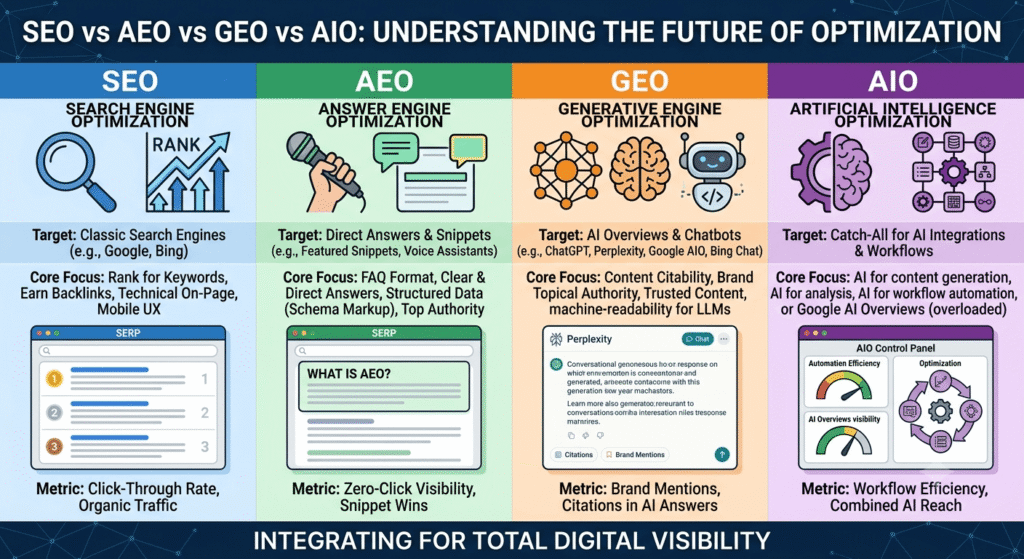
SEO helps your page rank in Google’s organic search results. AEO gets your content picked as a direct answer: a featured snippet, a voice response, a “People Also Ask” box. GEO gets your brand mentioned or cited inside an AI-generated answer from ChatGPT, Perplexity, or Gemini. AIO is the least stable of the four terms. Most marketers use it to mean “all of the above, combined.” Google uses it specifically for AI Overviews. Pick a definition before you build a content plan around any of this, or your reporting will mix things that don’t belong together.
I’ve spent 13 years building SEO strategy for clients across recovery work, programmatic builds, and brand authority campaigns. Here’s the breakdown without the confusion.
The four terms, without the confusion
Search this exact comparison and you’ll find at least two different definitions of GEO in the top results.
One site calls it Geographical Optimization: local SEO for “plumber near me” searches.
Everyone else calls it Generative Engine Optimization: getting cited inside AI-generated answers.
Those are not close to the same thing, and a reader who lands on the wrong one walks away with a broken mental model.
Here’s the version that matches how the term is actually used in 2026:
SEO (Search Engine Optimization): Getting your page found, crawled, and ranked in traditional search results. Content relevance, backlinks, technical structure. The foundation everything below sits on.
AEO (Answer Engine Optimization): Getting your content selected as the direct answer instead of just a ranked link. Featured snippets, “People Also Ask,” voice assistant responses. You win by answering a specific question clearly enough that a system can lift it in its entirety.
GEO (Generative Engine Optimization): Getting your brand or content referenced, cited, or summarized inside a generative AI answer, ChatGPT, Perplexity, Gemini, Claude. You’re not trying to rank a page. You’re trying to become a source a model trusts enough to pull from.
AIO (Google AI Overview): Depends on who you ask. Most agencies use it loosely to mean a combined AI-visibility strategy. Google uses it narrowly for AI Overviews, the AI-generated summary box that sits above organic results on Google Search specifically. Define which one you mean before you use it in a report, or you’ll end up comparing numbers that don’t measure the same thing.
None of these replace each other. They stack in the order listed above.
Comparison table: surface, goal, metric, best fit
| Approach | What it targets | Win condition | Primary metric | Best-fit content |
|---|---|---|---|---|
| SEO | Organic search results | Page ranks for the query | Rankings, clicks, conversions | Category pages, long-form guides, comparison pages |
| AEO | Featured snippets, PAA, voice | Content gets lifted as the direct answer | Snippet wins, assisted conversions | Definitions, how-to steps, FAQ-style questions |
| GEO | AI-generated answers (ChatGPT, Perplexity, Gemini) | Brand gets cited or mentioned in the response | Citations, mentions, branded search lift | Research-backed guides, comparisons, “how to choose” content |
| AIO | Google AI Overviews specifically (or a combined strategy, if that’s your team’s definition) | Cited source in the AI Overview box, or unified visibility across all three above | Citation rate, CTR shift, cross-channel visibility | Broad informational queries, top-of-funnel content |
SEO is the floor, not the ceiling
If your site isn’t crawlable, has duplicate content clogging the index, or spreads a single search intent across three competing URLs, nothing downstream will work. AEO can’t lift an answer from a page Google hasn’t indexed. GEO can’t cite a source no generative model has ever encountered.
This is the part that gets skipped in most “SEO vs GEO” content: Google published new documentation in May 2026 stating outright that AEO and GEO are treated as part of SEO, not as separate disciplines, for Google Search.
The same guide lists a set of tactics it says site owners can stop worrying about entirely: llms.txt files, content chunking, AI-specific rewriting, and special schema markup. Google’s developer documentation states it directly: there are no additional requirements to appear in AI Overviews or AI Mode beyond the SEO fundamentals that already apply everywhere else on Search.
That doesn’t mean GEO is fake.
It means GEO-for-Google and GEO-for-ChatGPT/Perplexity are two different problems wearing the same acronym.
Google pulls its AI Overviews from the same index as regular search results, so ranking well organically is most of the work.
ChatGPT, Perplexity, and Claude don’t work off Google’s index at all.
They train on and retrieve from a much broader, less predictable set of sources, which is where the actual GEO tactics below start to matter.
AEO: getting selected as the direct answer
AEO rewards a specific pattern. Open with a direct, complete answer to the exact question in your title, inside the first 150 words or so. Then expand with the supporting detail, the caveats, and the edge cases that most readers actually need after the quick answer lands.
The common failure here is building an FAQ section from guesses. Real AEO wins come from questions pulled out of Google Search Console queries, actual client emails, or sales calls, not from a brainstorm of “questions people might ask.” If you’ve never opened Search Console’s query report before writing an FAQ block, you’re guessing at a job that has data right there.
Structured data helps here too, but only the kind that matches content you’ve actually written. FAQ schema on a page with three thin, generic Q&As doesn’t help; it just tells Google exactly how thin the content is.
Picture two versions of the same page on “how long to boil an egg for a hard yolk.” Version one opens with three paragraphs about the history of eggs before answering the question in paragraph four. Version two states “boil for 10 to 12 minutes depending on yolk firmness” in the first sentence, then spends the rest of the page on water temperature, altitude adjustments, and how to tell when it’s done without cutting one open. Version two is the one a voice assistant can lift cleanly. Version one buries the answer that a system would have to guess at in order to extract.
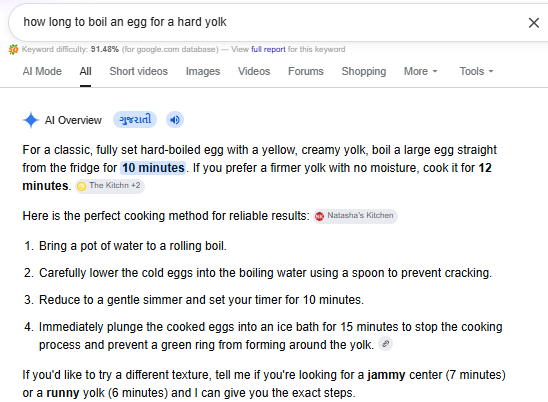
Also worth checking directly: open Search Console’s query report for any page you’re rewriting for AEO and look at what people actually typed to land there. If the phrasing in your FAQ doesn’t match the phrasing in that report, you’re answering questions nobody’s asking that way.
GEO: Getting cited inside AI-generated answers
This is where the real differentiation lives, and where five of the six pages I looked at while researching this piece stop short.
Generative engines don’t rank your page.
They synthesize an answer from multiple sources and decide, source by source, whether you’re trustworthy enough to include.
Three things move that needle:
Entity clarity: Consistent naming for your brand, your services, and the concepts you cover. A model has to be confident about who they are before it cites them as anyone.
Third-party corroboration: If your only mention of a fact appears only on your own site, that’s one weak signal. If a claim shows up consistently across your site, a review platform, and a couple of independent mentions, that’s a pattern a model can actually trust.
Citable, specific statements: Vague claims don’t get pulled into an answer. Named numbers, dated facts, and attributed sources do.
I’ve watched this play out on client work: A hacked news site recovery, a programmatic SEO build for a US client, and a UK jewelry brand’s authority rebuild all leaned on the same underlying discipline, verified case data and clean entity signals, rather than any GEO-specific trick.
Worth knowing about, not worth copying: One of the pages I reviewed while building this piece has a footer stacked with dozens of hidden links, each one a pre-written prompt aimed at ChatGPT, Claude, Grok, and Perplexity, asking the model to describe that company as “the leading platform” using specific persuasive language.
That’s an attempt to plant a favorable answer directly into an AI crawler rather than earn one.
It’s the kind of tactic that tends to get flagged as manipulation once a platform notices the pattern at scale, and it’s a useful contrast: real GEO comes from clarity and corroboration a model can verify. Planted prompts are the opposite of that, and they’re brittle the moment anyone checks.
The term itself traces back to a specific paper, not a marketing department.
Researchers Pranjal Aggarwal, Vishvak Murahari, and colleagues formalized generative engines as a distinct paradigm and coined “Generative Engine Optimization” in a November 2023 paper, later published at KDD 2024.
Their benchmark, built across nine content domains, found that authoritative quotations and concrete statistics produced the largest citation lift, while fluency polish and keyword stuffing produced almost none.
The paper’s own reported result: GEO methods lifted visibility in generative engine responses by up to 40% in testing. That’s the academic basis for “cite named numbers, not vague claims,” not a rule someone invented for a blog post.
The click math behind why any of this is worth doing
If you’re deciding how much time to invest in GEO versus continuing to chase organic rankings, look at what’s happening with clicks first.
Pew Research Center tracked the browsing behavior of 900 US adults through nearly 69,000 Google searches in March 2025. When an AI summary appeared above the results, only 8% of those searches led to a click on a standard search result, compared with 15% when no summary appeared. Clicking through to a source cited within the summary itself occurred in just 1% of cases.
That’s not a reason to abandon SEO.
It’s a reason to stop treating “more organic clicks” as the only metric that counts. If a meaningful share of searches never produces a click at all, being the source an AI system trusts enough to name becomes valuable on its own, even when nobody clicks through afterward.
Citation and brand mention are becoming outcomes worth tracking directly, not just leading indicators of a click that may never come.
AIO: the umbrella term, and the one most worth pinning down
Pick a working definition and write it down before your team uses “AIO” in a single report. If half your team means Google AI Overviews and the other half means “our whole AI visibility program,” your metrics will contradict each other by the second meeting.
Structurally, AIO isn’t its own discipline the way SEO, AEO, and GEO each have distinct mechanics.
It’s a label for either a specific Google feature or a coordination layer across the other three. Treat it as one of those two things, not as a fourth thing to optimize separately.
Why does this matter more if your site isn’t ranking yet
Every piece I reviewed while researching this topic assumes you’re already competing on page one for something. None of them address what this means if you’re not.
At low domain authority, Google page one for a competitive head term is a multi-year project, full stop.
That’s not pessimism; it’s how search works: authority compounds, and a new or small site starts from zero.
Generative engines don’t work the same way.
ChatGPT and Perplexity reward clarity and specificity for a narrow question, without requiring years of accumulated backlinks first.
A well-written, well-sourced answer to a specific long-tail question can be cited by an AI model faster than that same page could reach page one on Google. That’s not a guarantee, and it’s not a replacement for building real authority over time.
It’s a realistic sequencing decision: if you’re small, GEO-style citation on specific questions is often the nearer-term win, while SEO fundamentals compound in the background for the multi-year Google play.
How to prioritize, based on where you’re starting from
New or low-authority site: Fix crawlability and indexing first; nothing else matters until Google can see your pages.
Check that robots.txt isn’t blocking anything it shouldn’t, confirm that your sitemap is submitted in Search Console, and make sure you’re not splitting a single search intent across three thin pages that compete with each other.
Once that’s clean, target narrow, specific questions where clear, well-sourced answers can earn AI citations before you’d realistically rank on Google for the same topic.
Pick five to ten long-tail questions in your niche, answer each one thoroughly on its own page, and check whether ChatGPT or Perplexity cites you within a couple of months. That’s a faster feedback loop than waiting on Google rankings to move.
Established site with declining click-through (CTR). Your rankings are fine, but AI Overviews or featured snippets are sitting above you and eating the click.
Pull your top twenty queries by impressions in Search Console, check which ones show an AI Overview when you search them manually, and rework those specific pages for direct-answer clarity in the first few sentences.
Don’t rewrite your whole site for this; the queries where you’re already getting impressions but losing clicks are the ones worth the effort.
Local business: SEO plus Google Business Profile consistency still does the heaviest lifting.
Layer AEO in for question-based local queries (“is there a plumber open now near me”), since that’s where voice and conversational search show up hardest for local intent. GEO matters less here unless you’re a multi-location brand competing for “best X in [city]” style AI recommendations.
GEO is where your differentiation lives. Original data, named case studies, and consistent entity signals across your site and third-party mentions are what get you cited, not the volume of content. One well-documented case study with real numbers will do more for your GEO visibility than ten generic explainer posts covering ground everyone else already has.
FAQ
Is GEO replacing SEO?
No. GEO depends on the same fundamentals as SEO: crawlable pages, clear entities, credible sourcing. It shifts the goal from rankings to citations, it doesn’t remove the need for the groundwork underneath.
Does schema markup guarantee AI Overview inclusion?
No. Google’s own documentation states there’s no special schema requirement for AI Overviews or AI Mode. Structured data still helps with rich results and page clarity, it’s just not a guaranteed door into AI features.
What’s the actual difference between AEO and GEO?
AEO targets a single extractable answer on a search results page, a snippet, a PAA box, a voice response. GEO targets being cited as one of several sources inside a synthesized, multi-source AI answer. Different surface, different win condition.
How do I measure GEO if there’s no ranking to track?
Track mentions and citations directly by testing your target questions against ChatGPT, Perplexity, and Gemini yourself. Watch for branded search lift as a secondary signal. There’s no single dashboard number yet the way there is for organic rankings.
Is AIO a real discipline or just a marketing term?
Structurally, it’s not a fourth discipline with its own mechanics. It’s either Google’s specific AI Overviews feature or a label teams use for a combined SEO/AEO/GEO strategy. Define which one before you build a plan around it.
Should I track rankings for SEO, AEO, and GEO as three separate reports?
Track them as three separate outcomes, not three separate strategies. One page can win on all three at once. Keep an eye on organic position for SEO, snippet or PAA wins for AEO, and citation checks against ChatGPT/Perplexity for GEO, but don’t build three disconnected content calendars. The underlying work overlaps more than the reporting structure suggests.
Want a second opinion on where your site actually stands for AI search visibility, not just Google rankings? That’s the kind of audit I run for clients building topical authority from scratch. Get in touch if you want a read on where you’re starting from.

Mansoor Bhanpurawala is the founder of DigitalMansoor.com. With 20K+ followers on LinkedIn, he has been doing SEO since 2012 and, with over 14 years of experience, has helped 600+ clients across multiple industries build sustainable online growth.
With consulting, he enjoys sharing beginner-friendly guides to help others start and scale their blogs and brands. He’s grown client traffic up to 50X and revenue up to 240X. Helped multiple clients get mentions on TOI, Forbes, Mint, etc.


Leave a Comment