Summary
- White hat SEO follows Google’s guidelines and optimizes for users first. Black hat exploits loopholes and optimizes for the algorithm.
- Gray hat sits between the two. Not against the rules, but not fully in the spirit of them either.
- Black hat can win rankings fast, but it risks an algorithmic penalty or a manual action, up to full de-indexing.
- Fastest way to classify any tactic: would you explain it to a Google engineer without flinching?
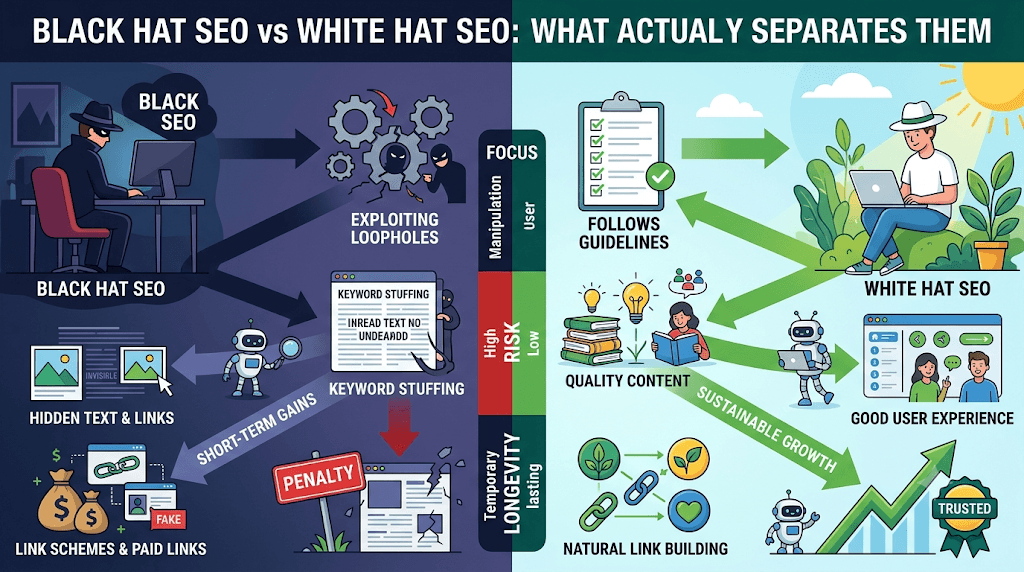
Black hat SEO uses tactics that violate Google’s guidelines to manipulate rankings, including keyword stuffing, cloaking, and link schemes. White hat SEO follows those guidelines and earns rankings by making a site genuinely better for its users. The real difference isn’t the tactic list, it’s who the work is for. Black hat optimizes for the crawler. White hat optimizes for the reader. Most real SEO work also runs through a gray zone in between, where intent matters more than the letter of the rule, and that’s the part most comparisons skip.
What Is White Hat SEO
White hat SEO means every ranking gain you make, you’d be comfortable explaining to Google directly. You’re not hiding anything from the algorithm or the visitor.
In practice, that looks like:
- Writing content that answers the actual question someone typed, not content built around a keyword count
- Earning links because other sites find your page worth citing, not because you paid for a placement
- Making the site fast and usable on mobile, because slow pages lose users regardless of what Google rewards
- Using descriptive titles and meta tags that tell both the reader and the search engine what the page actually covers
The tradeoff: it’s slower. You’re building something that has to hold up on its own merits, and that takes longer than gaming a loophole. The payoff is that it doesn’t get taken away in the next update.
What Is Black Hat SEO
Black hat SEO chases the ranking signal instead of the thing the signal is supposed to measure. If Google rewards backlinks, black hat buys backlinks instead of earning them. If Google rewards keyword relevance, black-hat SEO uses keywords instead of writing relevant content.
Common tactics:
- Keyword stuffing: cramming a phrase into a page far past the point it reads naturally
- Cloaking: showing search engines one version of a page and visitors a different one
- Doorway pages: thin pages built purely to funnel search traffic to another page, with no standalone value
- Link schemes: buying links, joining link farms, or swapping links purely to manipulate authority signals
- Hidden text or links: white text on a white background, or links stuffed in footer code nobody reads
These work in the sense that they can move rankings fast. They fail in that they offer only speed. Google has spent over a decade building detection specifically for this category.
Gray Hat SEO: The Zone Most Guides Skip
This is the part that gets left out of most black-hat vs white-hat comparisons, and it’s the part that actually matters day-to-day, because almost nobody sits purely in one camp or the other.
Gray hat tactics don’t break a written rule, but they push the spirit of one. A few real examples:
- Reviving expired domains for their existing backlink profile, then publishing unrelated content on them
- Aggressive guest posting at scale, where the primary goal is the link rather than genuinely useful placement
- AI-generated content published without editorial review, technically original text, but with nobody checking it’s accurate or useful
None of these will get you an instant penalty. All of them carry real risk if Google’s systems start treating the pattern as manipulation rather than coincidence, which is exactly what’s happened with several of the spam updates below.
Black Hat SEO vs White Hat SEO: Side by Side
| Dimension | Black Hat SEO | White Hat SEO |
|---|---|---|
| Who it’s built for | The algorithm | The person reading the page |
| Google’s guidelines | Violates them | Follows them |
| Speed of results | Fast, sometimes days | Slow, often months |
| Durability | Lost in the next update or manual action | Compounds over time |
| Typical techniques | Keyword stuffing, cloaking, link schemes, doorway pages | Original content, earned links, fast pages, clear site structure |
| Risk if caught | Ranking loss, manual action, or de-indexing | Effectively none |
| Long-term cost | High if it works and gets caught later | Low, front-loaded effort |
What Happens When Google Catches Black Hat SEO
This is the part most black-hat-vs-white-hat pages leave abstract. It isn’t abstract. Google has named and dated updates built specifically to catch these patterns.
- Panda (rolled out February 2011, folded into Google’s core algorithm in 2016): targets thin, low-quality, or duplicated content. Sites that existed mainly to rank rather than to help anyone lost visibility here.
- Penguin (rolled out April 2012, also folded into core in 2016): targets manipulative link profiles: paid links, link farms, over-optimized anchor text.
- Helpful Content Update (launched August 2022): targets content written primarily to rank in search rather than to genuinely help the reader, including a lot of the “gray hat” AI-content-without-oversight pattern above.
Beyond algorithmic updates, Google can also issue a manual action: a human reviewer flags a specific site for a specific violation, which is different from being caught in an algorithmic update and usually requires a reconsideration request to recover. Recovery timelines and specific criteria for manual actions vary by case, and Google doesn’t publish exact figures; treat any specific “X weeks to recover” claim you see elsewhere with caution.
The pattern across all of these: Google isn’t punishing a specific keyword trick. It’s getting better at detecting the gap between what a page claims to be and what it actually delivers, which is exactly why gray hat tactics carry more risk over time, not less.
How to Classify Any SEO Tactic in 10 Seconds
Skip the memorized lists. Ask these three questions about any tactic you’re considering:
- Would I explain this to a Google Search engineer without editing the explanation? If you’d need to leave out the “why,” that’s your answer.
- Does this help the specific person reading the page, or only the ranking? If it only helps the ranking, it’s black hat regardless of how technical it sounds.
- Am I relying on Google not noticing this pattern, or on the pattern actually being fine? “Not noticing yet” is gray hat, and gray hat has a shelf life.
If a tactic passes all three, it’s white hat. If it fails the first one outright, don’t do it, no matter what a “guru” thread says still works.
FAQ
Is gray hat SEO safe?
Safer than black hat, not safe. The risk isn’t an instant penalty; it’s that Google’s detection improves faster than most gray-hat tactics are abandoned.
Can black hat SEO still work in 2026?
Some tactics still produce short-term ranking gains. None of them hold up once detected, and detection has only gotten faster since Panda and Penguin.
What happens if Google catches you using black hat SEO?
Either an algorithmic ranking drop (from an update such as Panda, Penguin, or the Helpful Content Update) or a manual action by a human reviewer. Recovery requires fixing the underlying issue and, for manual actions, filing a reconsideration request.
Is keyword stuffing still a thing?
It still shows up, mostly from sites that haven’t updated their playbook since 2015. It doesn’t work the way it used to, and it actively hurts readability, which now matters more than the old signal it was chasing.
How do I know if my SEO agency is using black hat tactics?
Ask them to name the tactics and explain them plainly. If the explanation involves “don’t worry about how, it just works,” that’s the answer.

Mansoor Bhanpurawala is the founder of DigitalMansoor.com. With 20K+ followers on LinkedIn, he has been doing SEO since 2012 and, with over 14 years of experience, has helped 600+ clients across multiple industries build sustainable online growth.
With consulting, he enjoys sharing beginner-friendly guides to help others start and scale their blogs and brands. He’s grown client traffic up to 50X and revenue up to 240X. Helped multiple clients get mentions on TOI, Forbes, Mint, etc.


Leave a Comment