Summary:
- Off-page SEO in 2026 isn’t just about backlinks. Brand mentions, forum presence, and citation-worthiness in AI answers now carry real weight.
- Directory submission, article spinning, and social bookmarking are dead weight. They don’t affect rankings and can flag your backlink profile as low-quality.
- Digital PR, unlinked mention reclamation, broken link building, and authentic forum presence are the highest-leverage tactics right now.
- You don’t need a paid tool subscription to do most of this. Free-tier alternatives are called out throughout.
- AI citation now correlates more with brand authority signals than with raw backlink count. That changes what “off-page SEO” should mean for a small site in 2026.
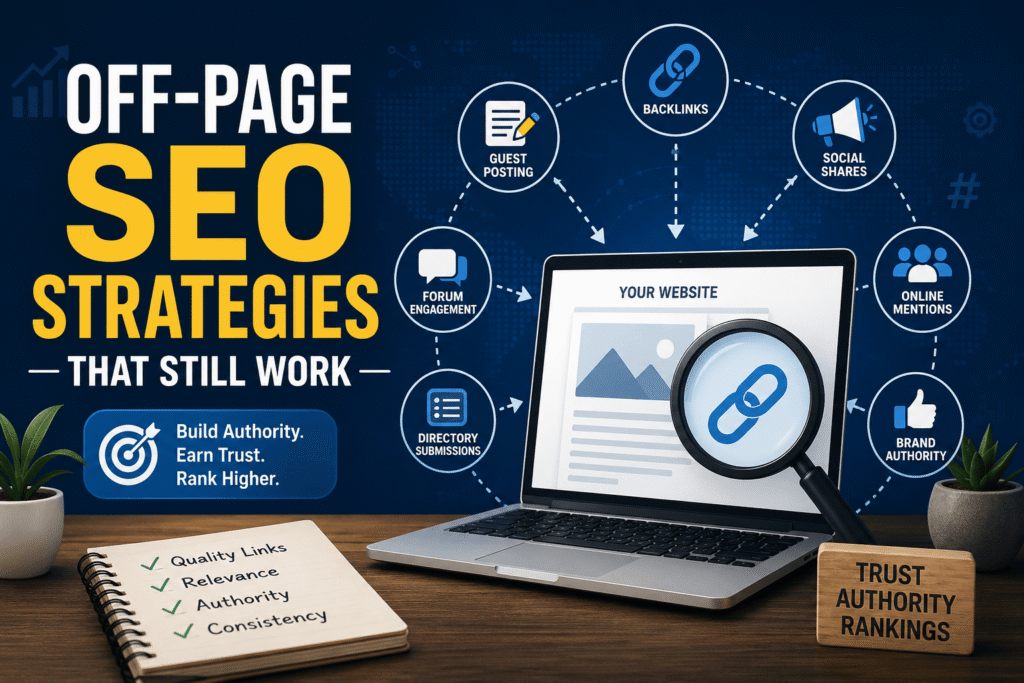
Off-page SEO means everything that builds your site’s authority and citability outside your own pages: backlinks, brand mentions, forum and community presence, and digital PR. Most off-page SEO content still relies on tactics from a decade ago, like directory submissions and article spinning, which do nothing for rankings now and can hurt the quality signal of your backlink profile. What actually works: earned backlinks from relevant sites, brand mentions whether linked or not, real forum participation, and digital PR. These are increasingly the same signals AI search tools use to decide who gets cited.
What Off-Page SEO Actually Means in 2026
On-page SEO is what you control directly: your content, your headers, your internal links. Off-page SEO is everything that happens elsewhere and still shapes how search engines and AI models see your site.
That used to mean one thing: backlinks. It doesn’t anymore. Two forces changed the definition.
First, zero-click search. Google searches ended without a click 68.01% of the time in the US during the first four months of 2026, up from 60.45% in 2024, according to SparkToro’s analysis of Similarweb clickstream data, reported by Search Engine Land. Fewer people are visiting your site even when you rank. More of them are reading an AI-generated answer instead.
Second, AI models don’t crawl your backlink profile the way Google’s ranking algorithm does. Seer Interactive’s research across a 10,000-question LLM dataset found that brand search volume has a correlation coefficient of 0.18 with AI mentions and a domain rank of 0.25, while backlinks showed little to no direct correlation once other factors were controlled for. That doesn’t mean backlinks are worthless. It means the old assumption that more links automatically mean more visibility everywhere doesn’t hold for AI-generated answers the way it holds for Google’s blue links.
So off-page SEO in 2026 has two jobs: earn the links and mentions that Google’s ranking algorithm still rewards, and build the brand-recognition signals that determine whether ChatGPT, Perplexity, and AI Overviews mention you at all.
The Off-Page Tactics That Are Dead (Stop Doing These)
A lot of “off-page SEO checklists” still floating around the internet were written for Google in 2016. If you’re doing any of the following, stop. Not because they’re risky. Because they don’t work anymore.
1. Directory and Article Submission
Submitting your site to generic web directories or spinning an article and posting it across low-quality article directories was a link-building shortcut a decade ago.
Google’s algorithm updates since then specifically target link networks built this way. The directories themselves have mostly become link farms with no real traffic or editorial standards.
You’re not building authority. You’re building a profile that looks manipulated.
2. Social Bookmarking Sites
Bookmarking your own content on sites like Digg or Diigo used to generate a trickle of backlinks and referral traffic.
Most of these platforms have lost relevance, and the links they generate carry no meaningful authority signal. The time is better spent getting one real mention on a site your actual audience reads.
3. Web 2.0 Submission and Spun Content
Creating throwaway blogs on Medium, Tumblr, or WordPress.com purely to host a backlink, or spinning the same article into a dozen slightly reworded versions, is a pattern that search engines are specifically built to detect.
It also does nothing for AI citations, since these platforms are rarely cited as authoritative sources on any topic.
If your current off-page checklist includes any of these three, replace them with what’s below.
What Still Works, Ranked by Leverage
1. Digital PR
Digital PR means creating something newsworthy enough that journalists, industry blogs, or niche publications write about it and link to you as the source. That could be an original data report, a survey of your industry, or a genuinely useful free tool.
This is the highest-effort, highest-return tactic on this list. One placement in a relevant trade publication does more for your authority than fifty low-quality directory links combined, and it’s exactly the kind of mention that shows up in AI training data and citation patterns.
Start small: Pitch a specific, narrow data point to a journalist who covers your niche, not a generic “we’re experts, please cover us” email.
2. Create Linkable Assets
Before you can do digital PR, you need something worth linking to. A linkable asset is content built specifically to attract links on its own merit: original research, a free calculator or tool, a genuinely comprehensive guide nobody else has written, or a well-designed data visualization.
The difference between a normal blog post and a linkable asset is intent. You’re not writing this primarily for search traffic. You’re building it so that other site owners, journalists, and forum users have a reason to reference it unprompted.
3. Broken Link Building
Find a page on a relevant, authoritative site that links out to a dead page, then offer your own content as a replacement.
This still works because it solves a real problem for the site owner: broken links hurt their user experience and their own SEO. You’re not asking for a favor; you’re fixing something for them.
Tools like Ahrefs’ broken link checker or the free version of Check My Links (a browser extension) can surface these opportunities without a paid subscription. The catch: your replacement content needs to actually match what the original dead page covered, not just be vaguely related.
4. Reclaiming Unlinked Brand Mentions
Someone mentions your brand name in an article or a forum post without linking to you. That mention already carries some authority, even without a link, but a link multiplies it and drives direct traffic.
Set up a free Google Alert for your brand name and any common misspellings. When you find an unlinked mention, reach out to the author with a short, specific, non-pushy request.
Most writers will add the link if you make it easy for them.
5. Authentic Forum and Community Participation
Reddit is the single most-cited domain across AI platforms according to Semrush’s AI Mode comparison research, and Google’s licensing deal with Reddit, first struck in 2024 and reportedly worth around $60 million a year, has continued to expand into 2026 as both companies negotiate broader AI training and search integration. That means genuine, non-promotional participation in relevant subreddits and niche forums carries real weight now, both for classic search visibility and for AI citation.
The rule that actually matters here: answer the question first, mention your site only when it’s genuinely the best answer, and never lead with a link. Forums and communities can tell the difference between a contributor and a marketer within one comment.
6. Guest Contribution on Genuinely Relevant Sites
Guest posting still works, but the bar moved. Posting on any site that accepts guest content for a backlink is nearly worthless now and can actively hurt you if the site is a known link farm. Posting on a site your actual target audience reads, with content that couldn’t have been written by anyone else, still earns real authority and referral traffic.
Test before you pitch: Would this site’s regular readers actually want to read what you’re proposing? If the honest answer is no, skip it.
7. Local SEO and Business Listings
If you serve a specific geographic area, this is one of the highest-ROI tactics on the list, and one of the most neglected.
Two parts matter:
- Google Business Profile: Keep it complete and current: accurate categories, real photos, regular posts, and prompt responses to reviews. This directly affects whether you show up in the local map pack for commercial searches.
- Business listings and citations: Directories like Justdial, IndiaMART, or industry-specific listing sites (Clutch for agencies, G2 for software) still carry weight, but only if your Name, Address, and Phone number (NAP) stay identical across every listing. Inconsistent citations actively confuse the local ranking signals you’re trying to build.
Unlike directory submission for generic backlinks, business listings serve a real function: they’re how customers and search engines confirm you’re a legitimate, findable business. That’s why they’re on the “still works” side of this list and generic directories aren’t.
Off-Page SEO Verdict Table
| Tactic | Still Works? | Effort | Best For |
|---|---|---|---|
| Digital PR | Yes | High | Established brands, agencies with a data story to tell |
| Creating linkable assets | Yes | High | Anyone with domain expertise or a niche audience |
| Broken link building | Yes | Medium | Sites with existing relevant content to offer as a replacement |
| Reclaiming unlinked mentions | Yes | Low | Any brand with existing media coverage or word of mouth |
| Forum and community participation (Reddit, niche forums) | Yes | Medium (ongoing) | Long-term brand and AI-citation building |
| Guest posting on relevant sites | Yes, selectively | Medium | Niche authority building, not volume link building |
| Local SEO and business listings | Yes | Low to Medium | Any locally-served business |
| Directory and article submission | No | — | Nobody, anymore |
| Social bookmarking | No | — | Nobody, anymore |
| Web 2.0 submission / spun content | No | — | Nobody, anymore |
How Off-Page SEO Now Overlaps With AI Search Visibility
This is the part most off-page SEO guides still miss entirely. AI Overviews now appear on roughly 48% of Google searches as of early 2026, according to BrightEdge tracking data. For a small site competing against established domains, ranking position one on Google for a competitive term is a slow, expensive fight. Getting cited by ChatGPT or Perplexity for a specific, long-tail question your ideal client is actually asking is a faster, more realistic win.
The off-page tactics above feed both goals, but not equally:
- Brand mentions and forum presence matter more for AI citation than for classic Google ranking, per the Seer Interactive correlation data above.
- Digital PR and linkable assets matter for both, since a genuine media placement builds the same authority signal AI models draw on.
- Directory submissions and spun content help neither. AI models are, if anything, better at detecting low-quality, templated content than Google is.
If you’re a consultant or small agency deciding where to put limited hours, this is the actual prioritization logic: pick the tactics that build a recognizable, citable brand presence, not the ones that just generate a link.
A 30-Day Off-Page SEO Starting Plan
If you’re starting from zero, here’s a realistic sequence:
Week 1: Set up free Google Alerts for your brand name and common misspellings. Audit your Google Business Profile if you serve a local market and fix any inconsistent NAP data across existing listings.
Week 2: Identify 5-10 unlinked brand mentions using your alerts and a manual search, then send outreach requests for each.
Week 3: Find 3-5 relevant subreddits or niche forums where your target audience actually discusses your topic. Spend the week reading before you post anything.
Week 4: Draft one piece of content built specifically as a linkable asset, whether that’s an original data point from your own work, a free tool, or a genuinely comprehensive resource nobody else in your niche has published.
Repeat weeks 2 through 4 as a rolling cycle. Digital PR and guest contributions take longer to pay off and are worth layering in once this foundation is running.
FAQ
Does guest posting still work for SEO in 2026?
Yes, but only on sites your actual target audience reads. Guest posting purely for a backlink on any site that accepts contributions carries little value now and can flag your link profile if the site is a known low-quality network.
Are backlinks still a ranking factor?
Yes, for classic Google search rankings. Backlinks matter less for AI-generated answer visibility, where brand mention frequency and domain recognition correlate more strongly, according to Seer Interactive’s research.
Do brand mentions without links help SEO?
Yes. Unlinked mentions still signal brand authority to search engines and, based on current research, appear to carry meaningful weight for AI citation likelihood. A link adds direct traffic and, on top of that, a stronger authority signal.
Is Reddit good for SEO?
Reddit is currently the most-cited domain across AI search platforms, and genuine, non-promotional participation in relevant subreddits builds both community trust and the likelihood of citations. Promotional posts or link drops get ignored or removed.
How long does off-page SEO take to show results?
Local SEO and business listing fixes can show up within weeks. Digital PR, forum authority, and brand mention accumulation typically take three to six months of consistent effort before the impact is measurable in rankings or AI citations.

Mansoor Bhanpurawala is the founder of DigitalMansoor.com. He has been doing SEO since 2012 and, with over 14 years of experience, has helped 600+ clients across multiple industries build sustainable online growth.
With consulting, he enjoys sharing beginner-friendly guides to help others start and scale their blogs and brands. He’s grown client traffic up to 50X and revenue up to 240X.
Leave a Comment