TL;DR
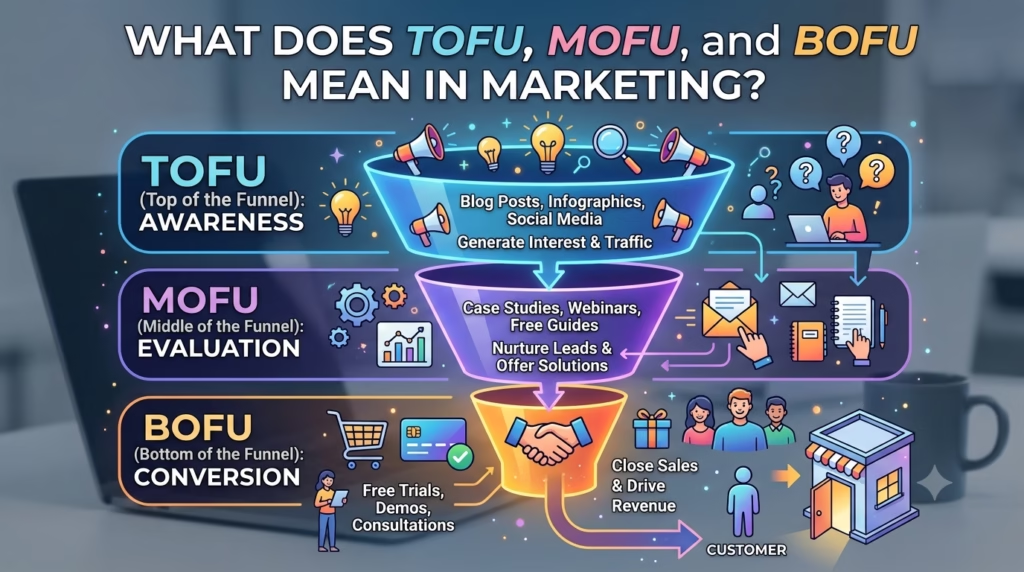
- TOFU (Top of Funnel) is the awareness stage. The buyer just found out they have a problem.
- MOFU (Middle of Funnel) is the consideration stage. The buyer is comparing solutions.
- BOFU (Bottom of Funnel) is the decision stage. The buyer is ready to choose and buy.
- Each stage calls for different content: educational at TOFU, comparative at MOFU, proof-driven at BOFU.
- Content that ignores which stage a buyer is in gets read and forgotten. Content matched to the stage gets buyers to act.
TOFU, MOFU, and BOFU stand for Top, Middle, and Bottom of Funnel the three stages a buyer moves through before they hand you money, mapped onto the broader buyer’s journey most marketing frameworks reference. TOFU content builds awareness. MOFU content helps a buyer weigh options. BOFU content pushes a ready buyer to convert. Mix these up, and you’ll hand a first-time visitor a pricing page, or bury a ready-to-buy lead in a “what is X” explainer. Both kill the sale.
What is TOFU (Top of Funnel)?
TOFU is the awareness stage. The person here doesn’t know your brand and often doesn’t even know they have a problem you solve. They’ve just noticed a symptom. Someone Googling “why is my email open rate dropping” isn’t looking for your product. They’re looking for an explanation.
Your job at this stage isn’t to sell. It’s to show up with something useful enough that they remember who gave it to them.
What belongs in TOFU content:
- Blog posts that answer a question, not pitch a product
- Social posts that explain a concept or share a quick tip
- Guides and checklists that solve a narrow, specific problem
- Original research or data that gets cited elsewhere
What TOFU content should avoid: product mentions beyond a soft signature link, gated forms (nobody trades an email for content at this stage), and jargon that assumes the reader already knows your category.
A B2B software company writing “5 signs your CRM data is unreliable” is TOFU. The reader has a problem. They don’t know yet that a CRM cleanup tool exists to fix it.
What is MOFU (Middle of Funnel)?
MOFU is the consideration stage. The buyer now knows they have a problem and knows solutions exist. They’re comparing options, reading reviews, and asking “which one actually works for someone like me.”
This is where you earn trust, not just attention. Content here should acknowledge that alternatives exist and make the case for why yours fits.
What belongs in MOFU content:
- Comparison pages (“X vs. Y”)
- Case studies with real numbers
- Webinars or demos that go deeper than a landing page can
- Email nurture sequences that answer objections one at a time
- FAQ pages that handle the “but what about…” questions
What MOFU content should avoid: treating every reader like they’re ready to buy today. Someone comparing three tools isn’t ready for a hard pitch. They’re ready for evidence.
If a reader lands on a page titled “how [tool] handles the problem you just researched,” and it includes a real customer result, that’s MOFU doing its job.
What is BOFU (Bottom of Funnel)?
BOFU is the decision stage. The buyer has narrowed their options and is deciding whether to commit to your product specifically, right now. They’re not researching anymore. They’re checking for reasons to say yes or no.
What belongs in BOFU content:
- Free trial or demo pages with a clear, low-friction next step
- Pricing pages that answer cost questions without forcing a sales call
- Testimonials and reviews that address specific hesitations (implementation time, support quality, switching cost)
- Direct comparison of your plan tiers against what the buyer actually needs
What BOFU content should avoid: vague promises. A buyer at this stage wants specifics: exact pricing, exact setup time, exact limitations. Hiding that information to force a sales call costs you buyers who’d rather self-serve.
TOFU vs. MOFU vs. BOFU at a glance
| Stage | Buyer mindset | Content types | Example | Goal metric |
|---|---|---|---|---|
| TOFU | “I have a problem” | Blog posts, social content, guides | “Why is my email open rate dropping?” | Traffic, reach, shares |
| MOFU | “I’m comparing solutions” | Comparisons, case studies, webinars | “[Tool] vs. [Competitor]: which fits a 10-person team?” | Email signups, demo requests |
| BOFU | “I’m ready to decide” | Trials, pricing pages, testimonials | “Start your free 14-day trial” | Conversions, sales-qualified leads |
How to map content to each funnel stage
Start by auditing what you already have. Pull your last 20 published pieces and sort them by which stage they actually serve, not which stage you intended. Most sites are TOFU-heavy and BOFU-light, because blog posts are easier to produce than comparison pages or pricing clarity.
Once you see the gap, fix it in this order:
- Check your BOFU content first. If someone ready to buy can’t find a straight answer on pricing, features, or setup, you’re losing people who already decided to say yes.
- Build one MOFU asset per competitor you regularly lose to. A direct comparison page beats a vague “why choose us” page every time.
- Keep TOFU content narrow. One question, one answer. Broad “ultimate guide” posts perform worse for conversion than tightly scoped answers, even when they rank well.
- Link stages together. A TOFU post should link to a related MOFU comparison. A MOFU comparison should link to a BOFU trial page. Don’t make the reader hunt for the next step.
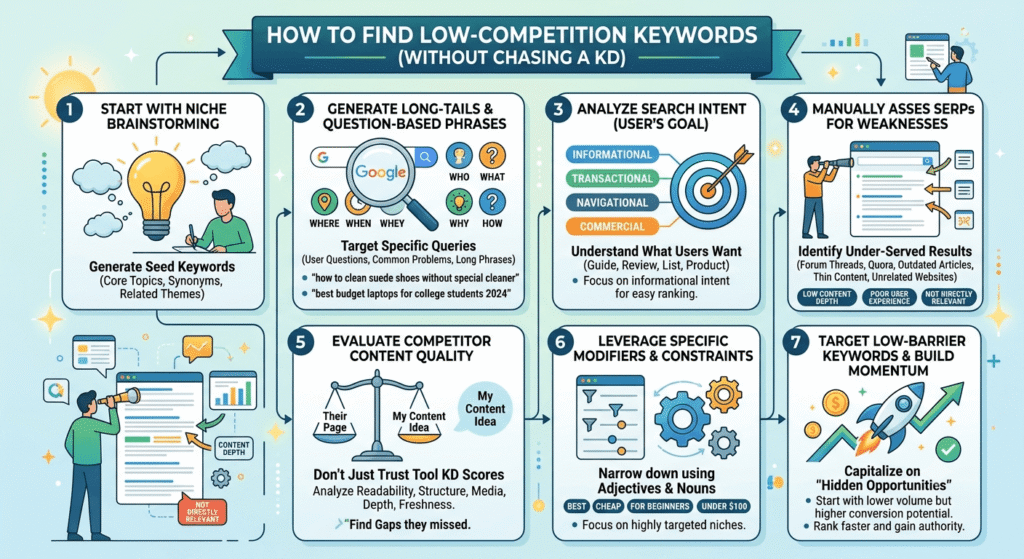
If you’re not sure which keywords cluster into which stage, low-competition keyword research is a useful starting point. Search intent usually maps cleanly onto funnel stage once you look past search volume.
Common mistakes with the TOFU/MOFU/BOFU model
Treating it as a one-way trip. Buyers loop back. Someone who read your TOFU post six months ago might return directly to a BOFU pricing page without ever touching your MOFU content. Don’t assume linear progression; make every stage able to stand alone.
Gating TOFU content. Forcing an email address for a basic blog post filters out the exact people you’re trying to reach at this stage: people who don’t know you yet and have zero reason to trust you with their inbox.
Skipping the audit. Publishing more content without checking which stage it fills doesn’t fix a funnel gap. It just adds more of what you already have too much of.
Ignoring how content gets discovered now. The funnel model was built for search-driven discovery, but buyers increasingly find TOFU-stage answers through AI tools like ChatGPT and Perplexity, not just organic search. Google’s own guidance on AI features confirms the same content fundamentals apply. Still, structuring content so it’s citable by AI search systems matters as much as ranking for it now.
FAQ
What does TOFU mean in marketing?
TOFU stands for Top of Funnel: the awareness stage where a buyer has just recognized a problem but doesn’t yet know what solutions exist.
What is the difference between TOFU and MOFU?
TOFU content builds awareness of a problem. MOFU content helps a buyer who already knows solutions exist compare and evaluate their options.
What comes after BOFU in the funnel?
Some marketers add a fourth stage after BOFU: retention or advocacy, focused on turning a new customer into a repeat buyer or referral source. It’s not part of the original three-stage model but is common in practice.
What content works best for each funnel stage?
TOFU works best with blog posts, guides, and social content. MOFU works best with comparisons, case studies, and webinars. BOFU works best with trials, pricing clarity, and testimonials.
Is the funnel model outdated?
The three stages still map to how people buy, but the paths between them aren’t linear anymore, and discovery increasingly happens through AI tools, not just search. The concept holds; treating it as a straight line doesn’t.

Mansoor Bhanpurawala is the founder of DigitalMansoor.com. With 20K+ followers on LinkedIn, he has been doing SEO since 2012 and, with over 14 years of experience, has helped 600+ clients across multiple industries build sustainable online growth.
With consulting, he enjoys sharing beginner-friendly guides to help others start and scale their blogs and brands. He’s grown client traffic up to 50X and revenue up to 240X. Helped multiple clients get mentions on TOI, Forbes, Mint, etc.

Leave a Comment