TL;DR
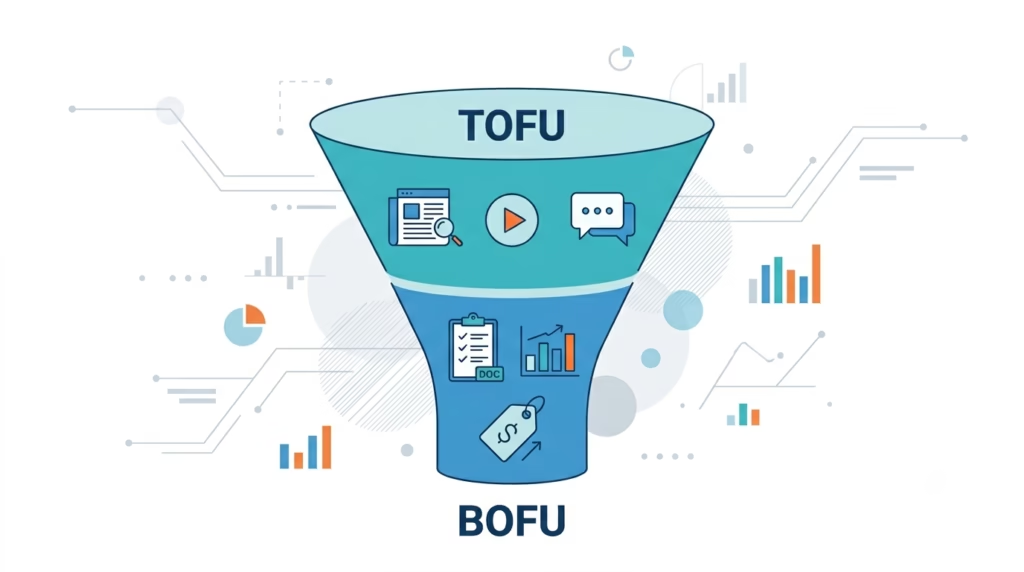
- TOFU (Top of Funnel) content targets people who don’t know your brand yet. Its job is awareness, not conversion.
- BOFU (Bottom of Funnel) content targets people who already know what they want and are deciding who to buy from. Its job is to close, not educate.
- Mix up the two and you get traffic that never converts, or sales pages nobody’s ready to read yet.
- MOFU sits between them as a bridge, not a third pillar competing for the same attention.
TOFU content introduces your brand to people who are still discovering they have a problem. BOFU content is built for people who already know what they want and are deciding who to buy from. The real difference isn’t where each one sits in the funnel. It’s the job each one has to do: TOFU earns attention, BOFU earns the decision. Get this wrong and you’ll keep publishing content that gets read but never converts, and you’ll spend money running ads for offers nobody’s ready to accept yet.
What Is TOFU (Top of Funnel)?
TOFU stands for Top of Funnel. It’s the content you publish for people who haven’t found you yet, don’t know your product exists, and aren’t ready to be sold to.
Someone reading TOFU content is usually searching a broad question, not your brand name. They’re trying to understand a problem, not compare vendors.
What TOFU content actually looks like:
- Educational blog posts (“What is technical SEO?”)
- Explainer videos and beginner guides
- Social posts that answer a common question
- Infographics and quick-reference content
- Podcast episodes on industry trends
None of it mentions pricing. None of it asks for a credit card. The only job TOFU content has is to be useful enough that a stranger remembers you when the problem gets serious.
How to measure it: organic traffic, impressions, time on page, new visitors, social shares. Not leads. Not revenue. If you’re grading TOFU content on conversion rate, you’re grading it on the wrong test.
What Is BOFU (Bottom of Funnel)?
BOFU stands for Bottom of Funnel. This is content for people who’ve already done their homework. They know the problem, they know roughly what solutions exist, and now they’re deciding who gets their money.
Someone reading BOFU content searches differently. They type “best [product] for [use case],” “[Brand A] vs [Brand B],” or your company name plus “reviews.” They’re not exploring anymore. They’re shopping.
What BOFU content actually looks like:
- Case studies with specific, named results
- Comparison pages (“us vs the alternative”)
- Pricing and service pages built to answer objections
- Client testimonials and video reviews
- Free trial, demo, or consultation offers
The job here isn’t to teach. It’s to remove every reason left to hesitate. A visitor hitting BOFU content should leave with one open question: how do I start?
How to measure it: demo requests, form fills, calls booked, conversion rate, cost per acquisition. If a BOFU page is getting traffic but no conversions, the content isn’t the problem. The offer or the trust signals are.
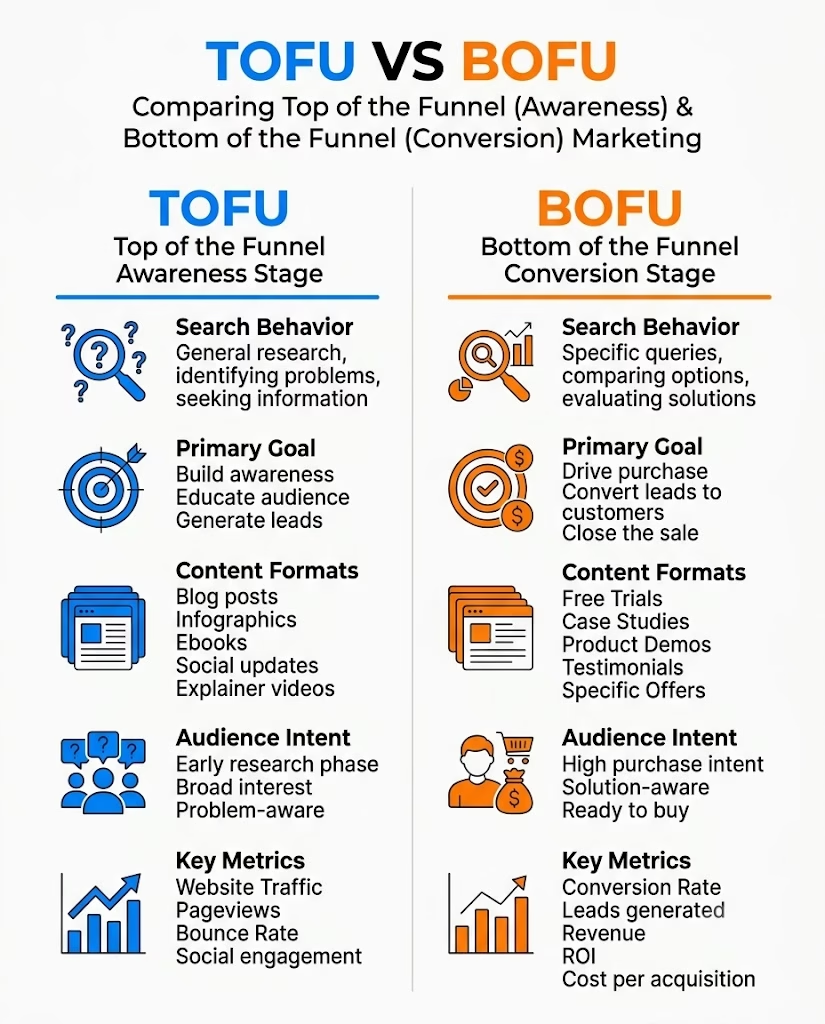
TOFU vs BOFU: Side-by-Side Comparison
| TOFU | BOFU | |
|---|---|---|
| Who they are | Strangers with a problem, not a plan | Prospects with a plan, deciding on a vendor |
| Search behavior | Broad, question-based (“what is…”) | Narrow, comparison-based (“best…”, “vs…”) |
| Content goal | Get noticed, build recall | Remove doubt, prompt action |
| Typical formats | Blog posts, videos, social, guides | Case studies, comparisons, pricing pages, demos |
| Tone | Educational, neutral | Specific, confident, evidence-first |
| What you measure | Traffic, impressions, shares | Conversions, calls booked, CAC |
| Content lifespan | Short. Trend-dependent. | Long. A strong case study still converts years later. |
That table is the whole answer to “TOFU vs BOFU” in one glance. Everything else in this piece is about applying it correctly.
Where Does MOFU Fit In?
Most explanations of this topic turn into a three-way lecture about MOFU before answering the actual question you searched. Here’s the short version, then we move on.
MOFU (Middle of Funnel) is for people who know they have a problem and are now evaluating how to solve it, but aren’t ready to talk to sales. Email nurture sequences, comparison guides, webinars, and gated lead magnets live here. It’s the bridge between “I have a problem” and “I’m ready to buy,” not a co-equal partner to TOFU and BOFU.
If you’re specifically comparing TOFU and BOFU, treat MOFU as connective tissue: it exists to keep a TOFU reader from disappearing before they’re BOFU-ready. It doesn’t need its own strategy debate every time TOFU and BOFU come up. It needs one job: don’t let the reader fall out of the funnel silently.
TOFU vs BOFU: Real Examples by Industry
Definitions are easy to nod along to and hard to apply. Here’s what the split actually looks like across different business types.
| Industry | TOFU Example | BOFU Example |
|---|---|---|
| SaaS | “What is customer churn and why does it happen?” | “How [Customer] cut churn by switching to [Product]” |
| E-commerce | “How to choose the right running shoe” | “[Product] vs [Competitor]: which one fits better?” |
| B2B services | “What does a fractional CFO actually do?” | “Case study: how we cut close time by 12 days” |
| Healthcare | “Signs you might need physical therapy” | “Patient reviews and outcomes for [Clinic]” |
| Finance / fintech | “How does a business line of credit work?” | “[Product] rates and terms compared to [Competitor]” |
| Local business | “How often should you get your HVAC serviced?” | “5-star reviews and before/after service photos” |
| Agency / consulting | “What is technical SEO and why it matters” | “How we grew [Client]’s organic traffic by a specific, verified amount” |
Notice the pattern. TOFU never names a product. BOFU almost always does, because by this stage the reader wants proof, not education.
How to Tell If Your Content Is TOFU-Heavy or BOFU-Starved
Skip the full content audit for a second and run this three-question test instead:
- Open your last 10 published pieces. How many mention your product, service, or pricing by name? If it’s 0 or 1, you’re almost certainly TOFU-heavy.
- Pull up your top 5 traffic pages. Do any of them have a specific next step beyond “read more”? If the answer is no, you’re generating attention with nowhere for it to go.
- Check your case studies or comparison pages. Do you have at least one, with real numbers, not “we helped them grow”? If you don’t, you have no BOFU content at all, regardless of how much you’re publishing elsewhere.
Fail two or more of these and the fix isn’t more blogging. It’s building the pages that convert the traffic you already have.
Why the Balance Between TOFU and BOFU Matters
A common starting framework, and it’s a framework, not a measured statistic, is roughly 40% TOFU, 30% MOFU, 30% BOFU for an established brand, shifting TOFU-heavy (60/30/10) for a brand new site still building traffic. Treat that as a starting point to adjust from, not a rule to hit exactly.
The reason the split matters isn’t abstract. TOFU content is genuinely rewarding to produce. It ranks, it gets shared, traffic charts go up, and it feels like progress. BOFU content is quieter work. A comparison page doesn’t go viral. But it’s the page that actually closes the person who was already convinced and just needed a reason to stop shopping around.
HubSpot’s overview of the marketing funnel and Content Marketing Institute’s content strategy resources are both useful if you want a deeper, vendor-neutral breakdown of how funnel stages map to content formats beyond what’s covered here.
There’s also a newer reason BOFU content matters more than it used to. When someone asks ChatGPT, Gemini, or an AI Overview which company to choose, the answer doesn’t come from a blog post. It comes from structured service pages, reviews, and specific, checkable claims, the same material that makes up BOFU content. A site with strong TOFU and no BOFU has plenty to rank, but nothing an AI system can confidently recommend.
This is why the balance question isn’t a nice-to-have for teams optimizing for search visibility in 2026. A blog full of educational posts and zero comparison pages, pricing clarity, or reviewable proof gives an AI engine nothing concrete to cite when a buyer asks which option to pick. The traffic still shows up in analytics. The recommendation goes to whoever built the BOFU page instead.
Common Mistakes When Mixing Up TOFU and BOFU Content
Sending BOFU traffic to a TOFU page. Someone searches your brand name plus “reviews” and lands on a generic blog post instead of a page built to close. That’s a wasted high-intent visit.
Writing BOFU content like it’s TOFU. “We help businesses grow” is TOFU language dressed up as a case study. BOFU readers want a name, a number, and a timeframe, not a mission statement.
No path from TOFU to BOFU. A blog post that ends without a next step is a dead end. Every TOFU piece needs a specific place to send readers who want to go deeper.
Treating one case study as “enough” BOFU. One case study, written two years ago, isn’t a BOFU strategy. It’s a placeholder. BOFU content needs to be current and specific to the reader’s actual situation, not a single generic proof point stretched across every offer.
Publishing BOFU content nobody can find. A comparison page or case study buried three clicks deep, with no internal links from your TOFU posts, does nothing. Every relevant TOFU piece should link to the BOFU page a reader would want next, not just to more TOFU.
A Simple Example: One Funnel, Two Content Types
Abstractions are easy to agree with and hard to apply, so here’s one funnel worked through end to end, using a local business as the example since the stakes are easy to picture.
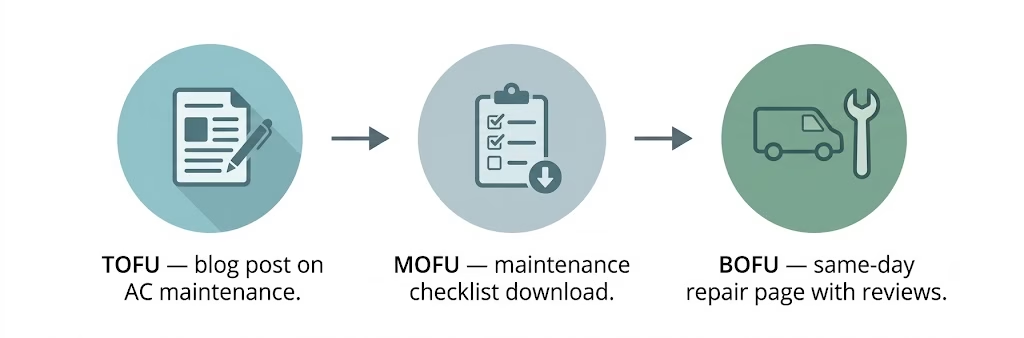
A mid-sized HVAC company wants more service calls. Their TOFU content is a blog post: “How often should you service your AC before summer?” It ranks for a broad, seasonal question. Nobody reading it has decided to hire anyone yet. That’s fine. Its only job is to show up when someone starts thinking about the problem, and to make the company look competent while doing it.
A reader who liked that post but isn’t ready to call yet might download a MOFU asset: a short “AC maintenance checklist” in exchange for an email address. Low commitment, useful on its own, and it keeps the company in front of the reader for a few more weeks without asking for anything.
Three weeks later, the AC breaks. Now the search changes entirely: “best HVAC repair near me” or the company’s name plus “reviews.” That’s a BOFU search, and it needs a BOFU page waiting for it: same-day availability, technician certifications, and a page full of specific, recent reviews with dates and photos. Not another blog post explaining how AC units work. That reader already knows. They need a reason to call this company instead of the next one in the results.
Same customer, same company, three completely different content jobs. Mixing up which content does which job, sending the “how often should you service your AC” reader a hard pitch, or making the person who’s ready to book wade through a general explainer, is where most funnels quietly leak.
Frequently Asked Questions
What does TOFU and BOFU mean in marketing?
TOFU means Top of Funnel: content for people who don’t yet know your brand and are still exploring a problem. BOFU means Bottom of Funnel: content for people who already understand their options and are deciding who to buy from.
Is a case study TOFU or BOFU content?
BOFU. Case studies work because they answer the exact question a near-ready buyer is asking: has this worked for someone like me? That’s a decision-stage question, not an awareness-stage one.
How much of my content should be TOFU vs BOFU?
There’s no fixed rule, but a common starting point is roughly 40% TOFU, 30% MOFU, 30% BOFU for an established site, shifting toward TOFU while you’re still building traffic. Adjust based on where your funnel is actually leaking.
What’s the difference between BOFU and a landing page?
A landing page is a format. BOFU is a funnel stage. Most BOFU content lives on landing pages, comparison pages, or pricing pages, but the label refers to the buyer’s intent, not the page type.
Can one piece of content work for both TOFU and BOFU?
Rarely, and usually not well. A piece trying to educate a stranger and close a ready buyer at the same time tends to do both jobs poorly. It’s fine to link between them, but keep the pages themselves focused on one stage.
Why isn’t my TOFU content converting into sales?
Because that’s not its job. TOFU content is measured by traffic and reach, not conversions. If TOFU traffic isn’t turning into revenue, check whether you actually have BOFU content for it to flow into, not whether the TOFU content itself is “working.”
Do B2B and B2C funnels split TOFU and BOFU differently?
The definitions stay the same, but B2B funnels usually have a longer, more MOFU-heavy middle since more people are involved in the decision. B2C purchases, especially lower-cost ones, can move from TOFU to BOFU in a single session.
What comes between TOFU and BOFU? Is that MOFU?
Yes. MOFU (Middle of Funnel) is the bridge stage for people who know they have a problem but aren’t ready to talk to sales yet. It exists to keep TOFU readers from disappearing before they reach BOFU.

Mansoor Bhanpurawala is the founder of DigitalMansoor.com. With 20K+ followers on LinkedIn, he has been doing SEO since 2012 and, with over 14 years of experience, has helped 600+ clients across multiple industries build sustainable online growth.
With consulting, he enjoys sharing beginner-friendly guides to help others start and scale their blogs and brands. He’s grown client traffic up to 50X and revenue up to 240X. Helped multiple clients get mentions on TOI, Forbes, Mint, etc.

Leave a Comment