TL;DR
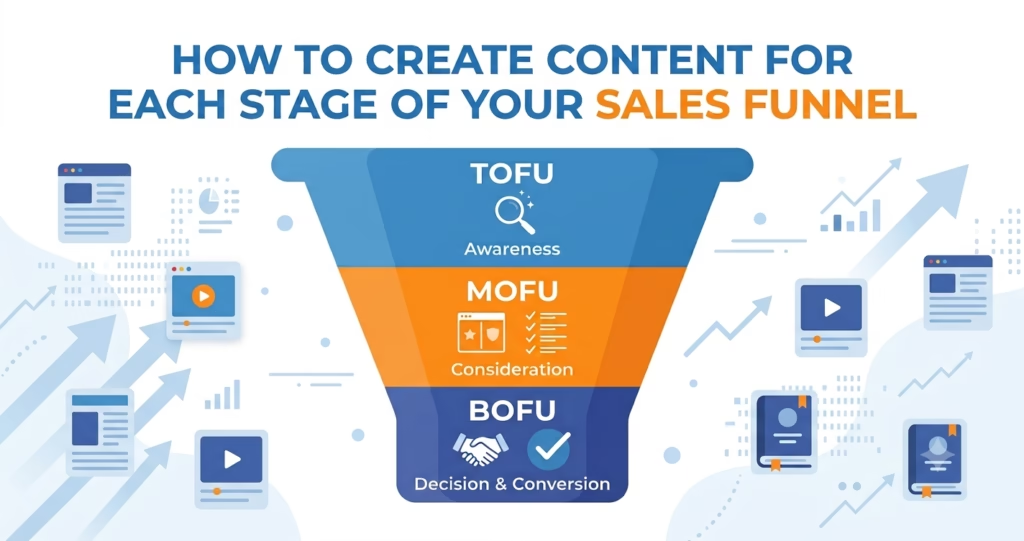
- Every sales funnel has four stages: Awareness, Consideration, Decision, and Retention. Each one needs a different type of content, not a scaled-down version of the same blog post.
- Awareness content answers questions. Consideration content builds trust with specifics. Decision content removes friction. Retention content gets skipped by almost everyone, which is exactly why it works.
- A content-type matrix (below) tells you what to build at each stage without guessing.
- Track different KPIs at each stage. Traffic matters at the top. Conversion rate matters at the bottom. Confusing the two wastes budget.
- Real example throughout: an Indian fintech client’s actual keyword and content strategy, anonymized, mapped stage by stage.
- A copy-paste template for each stage: blog post structure, case study structure, CTA structure, and a 4-email onboarding sequence.
- A free tool for each stage, placed where you’d actually use it: Keyword Search Intent Identifier and Headline Analyzer for Awareness, Readability Test Tool for Consideration, CTR and ROAS Calculators for Decision, Customer Lifetime Value Calculator for Retention.
Creating content for each stage of your sales funnel means matching the format and message to what a buyer needs at that exact moment: informational content for people who don’t know you yet, comparison and proof for people evaluating you, and friction-free CTAs for people ready to buy. Most content plans skip this and write the same generic blog post for every stage, which is why most content plans underperform. Get the stage-to-content match right, and every piece does one job well instead of every piece doing no job particularly well.
The 4 Stages of the Sales Funnel, Mapped to Content
| Stage | Buyer mindset | Content job |
|---|---|---|
| Awareness | “I have a problem” | Educate, get found |
| Consideration | “I’m comparing options” | Build trust, prove it works |
| Decision | “I’m ready, but not quite” | Remove the last objection |
| Retention | “I already bought” | Keep them, turn them into advocates |
Skip a stage, and you lose buyers who fall through the gap. Write only Awareness content, and you generate traffic that never converts. Write only Decision content (pricing pages, demos, CTAs) with nothing upstream, and nobody finds you in the first place.
Content Type Matrix: What to Create at Every Stage
| Stage | Content types | Primary goal | Example CTA |
|---|---|---|---|
| Awareness | Blog posts, evergreen listicles, short-form video, infographics, free tools | Get found in search, establish expertise | “Read the full guide” |
| Consideration | Case studies, comparison pages, webinars, real-time/reactive content, email nurture | Build credibility with specifics | “See how it works” |
| Decision | Pricing pages, live demos, testimonials, limited-time offers | Remove friction | “Start your free trial” |
| Retention | Onboarding sequences, loyalty programs, exclusive content, remarketing | Keep the relationship, drive repeat business | “Here’s what’s new for you” |
This table is the shortcut. If you’re stuck on what to write next, find your buyer’s current stage in the left column and pick from that row, not the whole list.
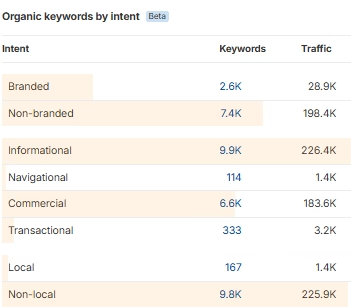
Informational keywords (9.9K keywords, 226.4K traffic) outweigh commercial (6.6K keywords, 183.6K traffic) and transactional (333 keywords, 3.2K traffic) by volume, which tracks with the funnel shape: wide at Awareness, narrower at every stage after.
Transactional keywords are the smallest bucket and the most valuable one to get right, since that’s where the CTA lives.
Awareness Stage Content (Top of Funnel)
What buyers need at this stage
At Awareness, the buyer knows they have a problem but hasn’t connected it to your product yet. They’re searching for answers, not vendors. Content here has to be useful on its own, with zero pitch, or the reader bounces before they trust you enough to read a pitch anyway.
Best content types
Blog posts and SEO articles that answer a specific question rank well and build the initial trust.
Publishing frequency backs this up with real numbers: HubSpot’s analysis of over 13,500 companies found that businesses publishing 16 to 20 posts a month got roughly double the traffic and triple the leads of companies that didn’t blog at all, and businesses publishing more than 20 posts a month saw the gap widen further (HubSpot). Consistency compounds. A single great post rarely does.
Before you publish, run the headline through my free tool Headline Analyzer to check whether it’s specific enough to earn a click instead of a scroll-past.
Short-form video works on platforms where your audience already scrolls.
Infographics get shared because they compress a concept into something skimmable. Free tools, calculators, or checkers work harder than any of these because they give value before asking for anything, and they tend to earn backlinks and repeat visits on their own.
Real example: evergreen listicles at scale
My fintech client’s content team publishes evergreen roundups titled in a consistent pattern: “[Number] Best [Category] Stocks in India [current Month Year],” refreshed periodically so the year and figures stay current. These target high-volume informational searches (“low P/E ratio stocks,” “gold stocks,” “high volatility stocks”) and don’t pitch anything in the headline or the intro. The pitch shows up later, once the reader has gotten what they came for.
Real example: utility-lookup content counts too
The same client ranks in the top 3 positions for queries like “gold rate today” and “silver rate today,” each pulling well over 100,000 monthly searches. Neither query mentions the company, a product, or a purchase decision. Both are pure Awareness-stage traffic, and both compound: a reader who checks the gold rate today comes back tomorrow, and eventually notices there’s a broker attached to the page they keep landing on.
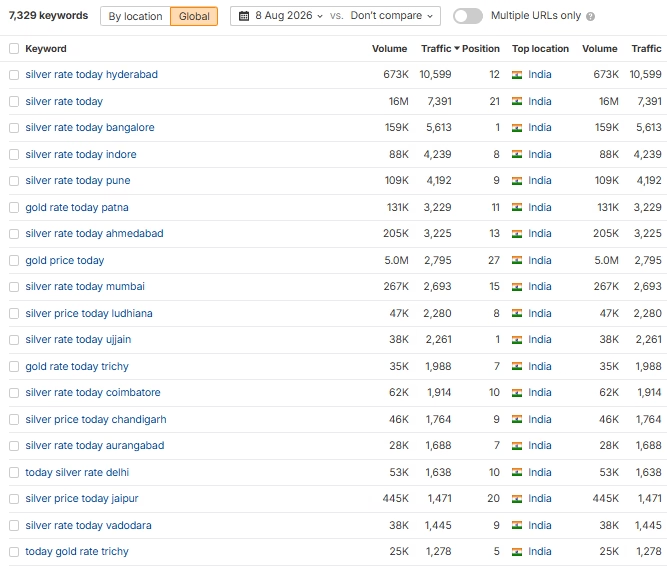
Ahrefs data of the same client. “Silver rate today hyderabad” alone pulls 673K monthly volume at position 12. “Gold price today” pulls 5M volume. Zero purchase intent in any of these queries, and that’s exactly why they work as Awareness content.
Template: Awareness blog post
Copy this and fill in the brackets.
Title: [Number] Best [Category] for [Use Case] in [Year]
Meta description: [What the reader gets] + [why it’s credible] + [what makes this list different]. Under 155 characters.
Intro (2-3 sentences): Open with the direct answer or the short list itself. State who this is for. No pitch.
Body: One section per item, each with a one-line “why it made the list” and a specific number or spec, not a vague adjective.
Close: One line pointing to the next logical question, linked to your Consideration-stage content.
Keywords to target at this stage
Target informational-intent phrasing: “how to,” “what is,” “guide to,” “best [category] for [use case],” or direct utility queries like “[thing] today” or “[thing] rate.” These have the highest search volume in most industries and the lowest buying intent, which is the point. You’re not selling here. You’re getting found.
Don’t guess at intent. Run your target keyword through my free tool like Keyword Search Intent Identifier before you write, so the format matches what the searcher actually wants instead of what you assume they want.
Consideration Stage Content (Middle of Funnel)
What buyers need at this stage
The buyer knows their problem and is now comparing solutions.
They want detail, proof, and a reason to trust one option over another.
Vague claims lose here.
Specific numbers, named sources, and real examples win.
Best content types
Case studies show a real outcome instead of a promised one, and buyer research backs up why they carry so much weight: multiple B2B buyer surveys (Content Marketing Institute, Demand Gen Report, and related industry research) put case studies among the top two or three most-trusted content types in a purchase decision, consistently ahead of product pages and generic blog content.
Treat that range as directional rather than a single precise figure; the exact percentage moves depending on which year’s survey you pull, but the ranking rarely changes.
Comparison pages do the evaluation work the buyer was going to do anyway, so let them do it on your page instead of a competitor’s. Webinars and live demos let a buyer ask questions in real time. Email nurture sequences keep the relationship alive between the first visit and the eventual decision.
Consideration-stage content is longer and denser than Awareness content by design, which is exactly why it fails most often on clarity. Run your case study or comparison draft through my free Readability Test Tool before you publish.
A buyer weighing three vendors won’t fight through a dense paragraph to find your proof point. They’ll leave and read a competitor’s instead.
Real example: real-time reactive content as a trust signal
The same fintech client publishes same-day articles reacting to market events, structured consistently: Market Performance, then Main News, then Company and Financial Details with exact figures (opening price, intraday high, intraday low), then a Summary. Each piece carries a named byline and a stated read time. A reader comparing two brokers for accuracy and speed sees a dated, numbered, bylined article next to a competitor’s vague commentary and the comparison makes itself.
Template: Consideration case study
Copy this structure for any customer story.
Headline: How [Customer type, anonymized if needed] achieved [specific, numbered result] in [timeframe]
The problem (1 paragraph): What wasn’t working, in the customer’s own situation, before any mention of your product.
The approach (1-2 paragraphs): What was tried, specifically. Name the tactic, not just the category (“published evergreen listicles targeting informational keywords,” not “did content marketing”).
The result (1 paragraph, with numbers): Exact figures where you have them. A range with a caveat where you don’t. Never a vague “significant improvement.”
The takeaway (2-3 sentences): What a reader in a similar position should try first.
Trust signals that actually move consideration-stage buyers
Precision beats polish at this stage. Exact figures instead of round ones. A named author instead of “Team” or “Admin.” A publish timestamp on the same day as the event it describes. These are small details, and they’re exactly the details a buyer checks when they’re deciding whether to trust you with money.
Decision Stage Content (Bottom of Funnel)
What buyers need at this stage
The buyer has decided to solve the problem and is choosing who to solve it with. They know what they want. Your job is removing whatever’s left in the way: uncertainty about price, doubt about ease of setup, or just inertia.
Best content types
Pricing pages with clear, comparison-ready numbers. Live demos or free trials that let the buyer try before committing. Testimonials placed at the exact point of hesitation, not buried on a separate page. Limited-time offers, used sparingly, to convert a buyer who’s already decided but hasn’t acted yet.
CTA copy that converts
Skip generic urgency (“Act Now!”) and be specific about what happens next: “Start your free trial, no card required” tells the buyer exactly what they’re agreeing to. “See your first month’s numbers before you pay” removes a specific objection instead of a vague one.
The best Decision-stage CTA answers the buyer’s actual hesitation, which means you need to know what that hesitation is before you write the button.
Template: Decision-stage CTA
Copy this and fill in the specific objection you’re removing.
Primary CTA: [Action verb] your [specific outcome], [what removes the risk] Examples: “Start your free trial, no card required.” “Open your account free, zero balance required.” “See your numbers before you commit.”
Supporting line beneath the button: One sentence naming the exact hesitation this removes (cost, setup time, commitment, risk) and how the offer handles it.
Trust element next to the CTA: A specific number, not a vague claim. “Trusted by [exact user count]” beats “Trusted by thousands.”
Two free tools optimize this stage specifically, because a strong CTA that nobody sees or nobody pays for doesn’t close anything.
Use my CTR Calculator to check whether your pricing page or product listing is earning clicks from search at a reasonable rate before you assume the copy is the problem.
Use the ROAS Calculator if you’re running paid promotion behind this content, so you know whether the spend is actually profitable and not just driving traffic that never converts.
Real example: the CTA lives inside the content, not next to it
The same fintech client places its primary conversion CTA (open an account) directly inside its informational and reactive articles, right after the data-backed summary, not on a separate landing page the reader has to be routed to.
The keyword data confirms this stage gets deliberate targeting of its own: transactional queries like “forex demat account” and “forex trading account opening in india” show up as dedicated ranking targets, not just an afterthought CTA bolted onto unrelated content.
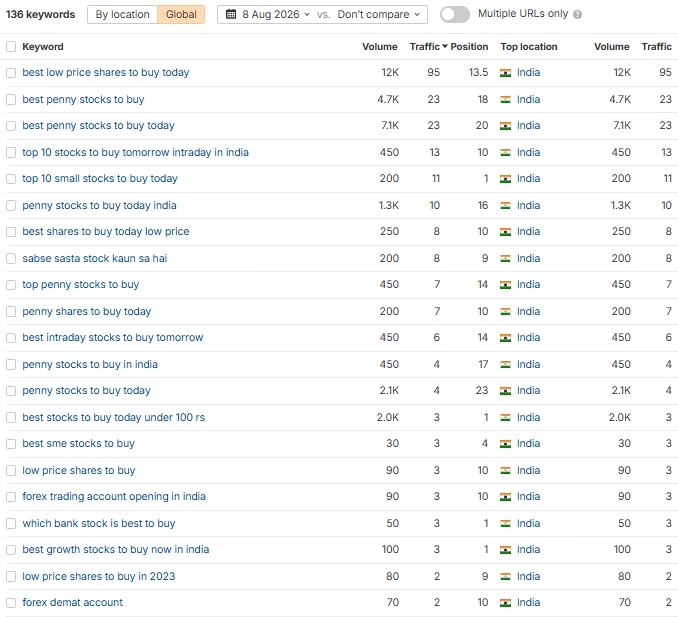
Lower search volume than the Awareness-stage table, and that’s expected: fewer people are ready to open an account than are checking a price. “Forex demat account” and “forex trading account opening in india” both sit in the top 10, which is deliberate targeting, not a lucky ranking.
Retention Stage Content (Post-Purchase)
Why retention content gets skipped, and shouldn’t
Most content calendars stop at the sale. That’s a mistake with a well-documented cost: research published in Harvard Business Review by Bain & Company’s Frederick Reichheld found that acquiring a new customer costs 5 to 25 times more than retaining an existing one (HBR). If your content strategy ends at checkout, you’re paying full acquisition price for every single sale, repeat customers included.
Best content types
Onboarding content gets a new customer to their first real result fast, which is the single biggest lever against early churn. Most churn research points the same direction: a large share of customer churn happens in the first 90 days after signup, concentrated among customers whose onboarding never got them to a clear first result. The exact percentage varies by source and industry, so treat any single figure with caution, but the pattern is consistent enough to act on: fix onboarding content before you spend more on acquisition.
Use my free Customer Lifetime Value Calculator to put a real number on what a retained customer is worth to you before deciding how much retention content is worth investing in.
Template: Retention onboarding email (first 7 days)
Copy this sequence structure.
Email 1 (Day 0, immediately after signup): Confirm what they just did. One clear next action to reach first value fast.
No upsell.
Email 2 (Day 2-3): Show them one feature or use case tied directly to the problem that made them sign up.
One CTA.
Email 3 (Day 5-7): Ask a direct question: “Did you get to [first value milestone] yet?” Offer help if not, a next-level tip if yes.
Email 4 (Day 14, optional): Introduce one thing they haven’t used yet, framed around a result, not a feature list.
Loyalty programs reward repeat purchases directly. Exclusive content, like advanced guides or early access, gives existing customers a reason to stay engaged instead of going quiet. Remarketing brings back people who’ve gone quiet before they fully leave, and it’s one of the better-documented tactics in this stage: several ad-platform and analytics studies report that retargeted visitors convert at multiples of the rate of cold, first-time visitors. Published lift estimates vary widely by industry and platform, so run your own numbers before you commit budget, but the direction of the effect is well established.
Real example
If you have onboarding sequences, loyalty content, or remarketing creative you’re willing to share (anonymized), it belongs here instead of a generic placeholder.
Common Content-Funnel Mistakes to Avoid
Writing Decision-stage content for an Awareness-stage audience: A pricing page or a “Book a demo” CTA does nothing for a reader who just learned their problem has a name. Match the pitch to the stage or the reader leaves before they’re ready.
Treating every visitor as bottom-of-funnel: Retargeting everyone who touched your site with the same aggressive discount email burns goodwill on people who were never close to buying. Segment by what they actually did, not just that they showed up once.
Measuring the wrong KPI at the wrong stage: A blog post judged on conversion rate looks like a failure even when it’s doing exactly its job: getting found. A pricing page judged on impressions looks like a success even when nobody’s converting. The KPI table below exists to prevent this exact mistake.
Stopping at the sale: Covered above, but worth repeating: the funnel doesn’t end at checkout, and content plans that treat it that way pay full acquisition cost for every repeat sale.
One CTA for the whole funnel: “Contact us” works nowhere as well as a stage-matched CTA works everywhere. “Read the guide” for Awareness, “See how it works” for Consideration, “Start your free trial” for Decision; each does one job instead of one CTA doing none of them well.
How to Measure Funnel Content Performance
| Stage | KPIs that matter | What they tell you |
|---|---|---|
| Awareness | Organic traffic, impressions, social shares, bounce rate | Are you getting found, and is the content relevant once they land? |
| Consideration | Time on page, lead sign-ups, click-through rate | Is the content detailed enough to hold attention and move someone forward? |
| Decision | Conversion rate, average order value, customer acquisition cost | Is the content closing, and is it closing profitably? |
| Retention | Repeat purchase rate, churn rate, customer lifetime value | Are you keeping what you paid to acquire? |
Track Awareness metrics against Decision metrics, and you’ll draw the wrong conclusion every time. High traffic with low conversion doesn’t mean your Decision content failed. It might mean your Awareness content is attracting the wrong audience entirely. The CTR and ROAS calculators linked in the Decision section above cover the two numbers most teams get wrong at that stage; the same principle (measure the stage you’re actually testing, not a proxy for it) applies to every row in the table.
FAQ
What is the 3-3-3 rule in sales?
The 3-3-3 rule is a sales prospecting guideline: spend the first 3 minutes of a call building rapport, ask 3 key qualifying questions, and aim to identify 3 specific pain points before pitching. It’s a conversation framework, not a content framework, but the same logic applies to content: earn attention before you pitch.
What are the 5 stages of a sales funnel?
Most frameworks use 4 stages (Awareness, Consideration, Decision, Retention), but some split Decision into two parts, Intent and Purchase, or add Advocacy as a fifth stage after Retention. The stage count matters less than making sure your content covers the full arc from “doesn’t know you” to “recommends you.” A 4-stage model that’s actually executed beats a 5-stage model that exists only on a slide.
How do I create content for each stage of the sales funnel?
Match content format to buyer intent at each stage: educational, no-pitch content for Awareness; detailed, proof-heavy content for Consideration; friction-removing content for Decision; and relationship content for Retention. Use the content-type matrix above as a starting checklist for each stage.
What’s the difference between a marketing funnel and a sales funnel?
A marketing funnel typically covers everything up through lead generation (Awareness and Consideration), while a sales funnel extends through the actual purchase and often into retention. In practice, most teams use the terms interchangeably, and the content strategy underneath them is the same regardless of which label you use.
How much content do I need per funnel stage?
There’s no fixed number. The right test is coverage, not volume: does every common question a buyer has at each stage have at least one piece of content answering it? A single strong case study at Consideration outperforms five thin ones. Start by mapping your buyers’ actual questions per stage, then fill the gaps.
How do I know which funnel stage a piece of content should target?
Check the query or the question it answers, not the product it mentions. If the question could be answered without ever naming a brand (“what is X,” “how does X work”), it’s Awareness. If it involves comparing named options, it’s Consideration. If it’s about price, setup, or “how do I start,” it’s Decision. If the reader already has an account, it’s Retention.
Can one piece of content work for multiple funnel stages?
Rarely, and trying to make it happen usually weakens the piece for every stage instead of strengthening it for one. A blog post that opens with education and closes with a hard pitch loses Awareness readers at the pitch and frustrates Decision-ready readers who had to read past the education to get there. Write for one stage, then link to the next stage’s content instead of cramming both into a single page.
Putting Your Funnel Content Strategy Into Action
Pick one stage where your content is thinnest and start there. Most teams over-invest in Awareness because it’s the easiest content to produce and under-invest in Retention because it’s the easiest to forget. Use the content-type matrix as your checklist, match the KPI to the stage you’re measuring, and let real buyer questions (not assumptions) shape what you write next.
There’s a second payoff to getting this right that most funnel content plans never account for: the same specificity that moves a human buyer from Awareness to Decision is what gets a page cited by AI search engines. Content with named sources, exact figures, and a clear answer up front doesn’t just rank; it gets pulled into AI Overviews, ChatGPT, and Perplexity answers.
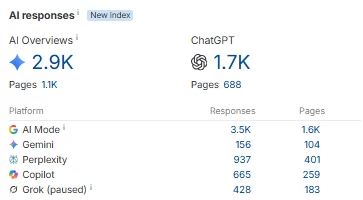
The same client’s content is showing up in AI answers at meaningful scale: 2.9K AI Overview responses across 1.1K pages, 1.7K ChatGPT responses across 688 pages, plus activity in Gemini, Perplexity, and Copilot in a month. That’s the compounding return on writing Awareness and Consideration content with real numbers and named sources instead of generic filler.

Mansoor Bhanpurawala is the founder of DigitalMansoor.com. With 20K+ followers on LinkedIn, he has been doing SEO since 2012 and, with over 14 years of experience, has helped 600+ clients across multiple industries build sustainable online growth.
With consulting, he enjoys sharing beginner-friendly guides to help others start and scale their blogs and brands. He’s grown client traffic up to 50X and revenue up to 240X. Helped multiple clients get mentions on TOI, Forbes, Mint, etc.

Leave a Comment