TL;DR
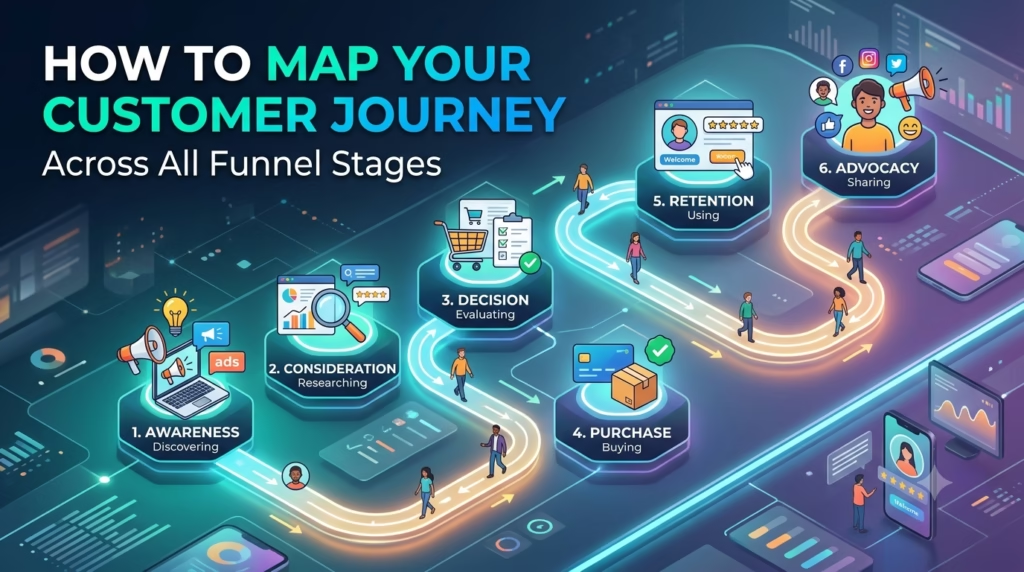
- The customer journey has 5 core stages: awareness, consideration, decision, retention, advocacy.
- Each stage sits at a specific point in your funnel: awareness and consideration are TOFU/MOFU, decision is BOFU, retention and advocacy happen after the funnel closes and feed back into awareness.
- A journey map that only names the stages doesn’t tell your team anything actionable. A funnel-mapped version pairs every stage with its touchpoints, the content that belongs there, who owns it, and the metric that proves it’s working.
- Building one takes six steps: define your personas, list touchpoints per stage, assign each stage a funnel position, assign an owner, assign a metric, then build and validate the map against real customer data — not assumptions.
What “mapping the customer journey across funnel stages” actually means
Most customer journey maps stop at naming the stages: awareness, consideration, decision, done. That tells you what a customer is thinking. It doesn’t tell you where your marketing or sales team should be standing when they’re thinking it.
Mapping the journey across funnel stages means tying each of the five journey stages to a specific position in your funnel — top, middle, or bottom — and then defining what happens at that intersection: which channel reaches the customer, what content answers their question, who on your team owns that moment, and what number tells you it worked.
Without the funnel layer, a journey map is a description. With it, it’s an operating document your marketing and sales teams can actually run against.
The 5 customer journey stages, mapped to funnel position
Here’s the mapping. Use this as the skeleton for your own map, then fill in the touchpoints and metrics specific to your business.
| Journey Stage | Funnel Position | Primary Touchpoints | Key Metric |
|---|---|---|---|
| Awareness | Top of funnel (TOFU) | Search, social ads, organic content, word of mouth | Reach, impressions, organic traffic |
| Consideration | Middle of funnel (MOFU) | Comparison content, reviews, retargeting ads, email nurture | Content engagement, email open/click rate, time on site |
| Decision | Bottom of funnel (BOFU) | Pricing page, demo, sales conversation, free trial | Conversion rate, demo-to-close rate |
| Retention | Post-funnel | Onboarding, support, product usage, account management | Churn rate, product usage frequency, NPS |
| Advocacy | Post-funnel, feeds back to TOFU | Referral programs, reviews, case studies, community | Referral rate, review volume, advocate-sourced leads |
Two things worth calling out about this table. First, retention and advocacy aren’t funnel stages in the traditional sense — the funnel model was built for acquisition, and it doesn’t have a slot for what happens after someone buys. Treating them as funnel stages is one of the most common mapping mistakes, and it’s covered below. Second, advocacy is the only stage that points back into TOFU: a referral from an advocate is itself a new customer’s first touchpoint, which is why journey maps are usually drawn as a loop, not a straight line.
Awareness: TOFU
A prospect doesn’t know your company solves their problem yet, or in some cases doesn’t know they have the problem. Your job at this stage is visibility, not persuasion. The content that works here answers a question or names a problem — it doesn’t pitch a product.
Consideration: MOFU
The prospect knows you exist and is comparing you against other options, including doing nothing. This is where comparison pages, case studies, and third-party reviews carry more weight than anything you write about yourself, because the prospect is actively trying to poke holes in your claims.
Decision: BOFU
The prospect has narrowed their options and is deciding whether to commit budget. Friction kills conversions here more than persuasion does — a confusing pricing page or a slow demo request form loses deals that content already won.
Retention: post-funnel
The sale closes the funnel, not the relationship. Retention runs on product usage and support quality, not marketing content. If your journey map treats “customer” as the end state, it’s missing the highest-leverage stage in the whole journey — a retained customer costs less to keep than a new one costs to acquire.
Advocacy: post-funnel, loops back to TOFU
Some customers become active promoters. This stage isn’t guaranteed by satisfaction alone — it usually needs a specific ask, like a referral program or a review request, timed to a moment when the customer has clearly gotten value.
How to build your funnel-mapped journey map
- Define your personas: A journey map built for “the customer” in general is too vague to act on. Build separate maps for each persona if their paths through the funnel differ meaningfully — a self-serve buyer and an enterprise buyer rarely take the same route.
- List every touchpoint per stage: Pull this from your actual data, not guesswork: analytics for organic and paid touchpoints, CRM notes for sales touchpoints, support tickets for post-sale touchpoints. If you don’t know where customers actually encounter your brand, the map will be fiction.
- Assign each stage a funnel position: Use the table above as a starting template, then adjust for your sales cycle. A long enterprise sales cycle might split “consideration” into two funnel sub-stages; a low-cost self-serve product might collapse consideration and decision into one.
- Assign an owner to each stage: Journey maps fail in practice when no one owns the handoff between stages — marketing owns awareness and consideration, sales owns decision, customer success owns retention, and someone specific needs to own advocacy, because it rarely happens on its own.
- Assign a metric to each stage: Pick one metric per stage that tells you whether that stage is working, not a dashboard full of vanity numbers. The table above lists a starting metric for each stage.
- Build the visual map, then validate it against real customer data: Lay out the stages left to right (or in a loop, to reflect advocacy feeding back into awareness), with touchpoints, owners, and metrics underneath each one. Then check it against actual customer behavior — session recordings, support transcripts, sales call notes — to see where the real path diverges from the assumed one. It usually does, and that gap is where the map earns its keep.
B2B vs. B2C: how funnel-stage mapping differs
The five stages stay the same across B2B and B2C. They diverge in funnel position and touchpoint mix.
B2B consideration stages tend to stretch across MOFU for longer, involve multiple stakeholders, and lean on content formats like whitepapers, ROI calculators, and security documentation that a B2C buyer never needs. A B2B decision stage often isn’t a single moment — it’s a sequence of internal approvals, which means your BOFU touchpoints need to serve people who never talked to your sales team directly, like a finance approver reviewing a proposal.
B2C journeys typically move faster through TOFU and MOFU, with social proof (reviews, influencer content) doing more work than in B2B, and the decision stage collapsing into a single purchase click rather than a multi-step approval chain. Retention and advocacy also work differently: B2C advocacy is often driven by individual satisfaction and public reviews, while B2B advocacy is more often driven by an account manager relationship and a formal case study or reference call.
If you’re mapping a B2B journey, expect your MOFU touchpoint list to be longer and your BOFU stage to include stakeholders who never appear elsewhere in your CRM.
Common mistakes when mapping funnel stages
Treating retention and advocacy as funnel stages: The funnel metaphor describes acquisition. Retention and advocacy happen after acquisition ends, which is why forcing them into a funnel shape (as if customers “fall out the bottom” into retention) undersells how different that phase actually is. Map them as a loop or a separate lifecycle stage, not a funnel continuation.
Building the map from assumptions instead of data: A journey map drawn in a workshop, with no analytics, CRM data, or customer interviews behind it, reflects what your team believes happens, not what actually happens. Validate every stage against real behavior before you call the map finished.
Skipping the owner and metric columns: A map with stages and touchpoints but no assigned owner or metric per stage is a diagram, not an operating document. It won’t survive contact with a team that needs to know who’s responsible for the consideration-to-decision handoff.
Building one map for every persona: If your self-serve and enterprise buyers take meaningfully different paths, one blended map hides that difference and leads to content and campaigns built for an average customer who doesn’t exist.
FAQ
What are the 5 stages of the customer journey?
Awareness, consideration, decision, retention, and advocacy. Awareness is when a prospect first encounters your brand; consideration is when they’re comparing options; decision is when they commit to a purchase; retention is keeping them engaged after the sale; advocacy is when they actively refer others.
How do funnel stages relate to customer journey stages?
Funnel stages (TOFU, MOFU, BOFU) describe where a prospect sits in your acquisition process. Journey stages describe what the customer is thinking and doing at each point. Awareness maps to TOFU, consideration to MOFU, and decision to BOFU. Retention and advocacy happen after the funnel and aren’t part of the traditional funnel model.
What’s the difference between a customer journey map and a sales funnel?
A sales funnel tracks volume and conversion rate at each acquisition stage. A customer journey map tracks the customer’s experience, touchpoints, and emotional state across the full relationship, including what happens after the sale. A funnel-mapped journey combines both: it shows the customer’s experience at each stage, plus where that stage sits in the funnel.
Do B2B and B2C customer journeys have the same stages?
The five stages are the same, but the funnel position, touchpoint mix, and timeline differ. B2B journeys typically spend longer in consideration, involve multiple stakeholders in the decision stage, and rely on different content formats than B2C journeys.

Mansoor Bhanpurawala is the founder of DigitalMansoor.com. With 20K+ followers on LinkedIn, he has been doing SEO since 2012 and, with over 14 years of experience, has helped 600+ clients across multiple industries build sustainable online growth.
With consulting, he enjoys sharing beginner-friendly guides to help others start and scale their blogs and brands. He’s grown client traffic up to 50X and revenue up to 240X. Helped multiple clients get mentions on TOI, Forbes, Mint, etc.

Leave a Comment