TL;DR
- TOFU marketing covers the activities that build awareness before someone knows they need you: content, SEO, social, PR, and paid reach. None of it pitches a product directly.
- Seven activities do the actual work: SEO and content, organic social, paid social and display, digital PR and outreach, influencer and podcast partnerships, referral and word-of-mouth, and community or offline reach.
- Track reach, engagement, and micro-conversions at this stage. Conversion rate belongs to MOFU and BOFU, not here.
- The 70/20/10 rule is the most common way teams split a TOFU budget: 70% on tactics with a track record, 20% on adjacent experiments, 10% on high-risk bets.
- Most guides list tactics and stop there. This one tells you when each one fits and what to measure.
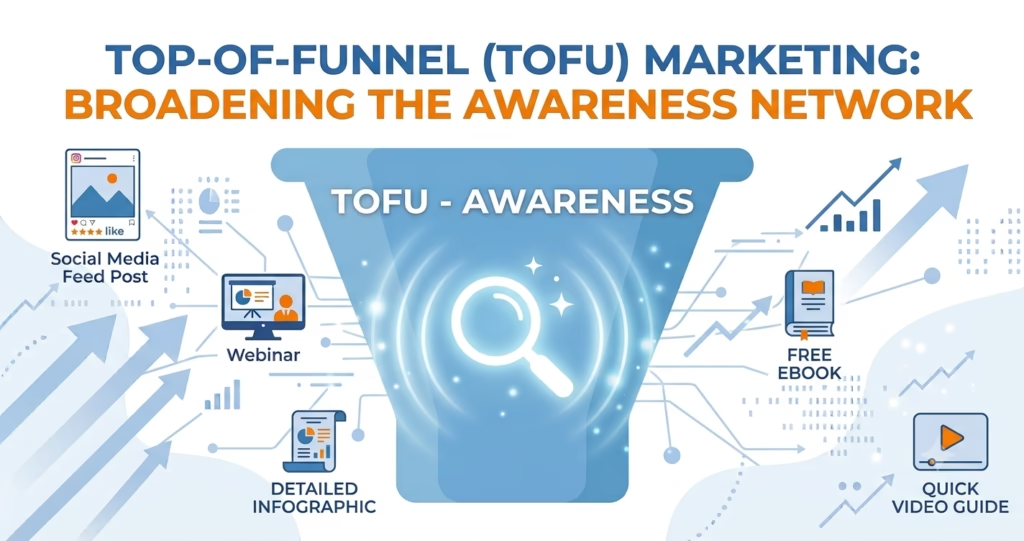
Top-of-funnel (TOFU) marketing is the set of activities that build brand awareness among people who don’t yet know they have a problem you solve: content, SEO, organic and paid social, digital PR, and influencer partnerships. None of it pitches a product. It earns attention by being useful, then lets a fraction of that audience move toward the next stage on their own.
I’ve run SEO and content programs for 14+ years across D2C brands, dental and medical ER practices, plumbing and moving companies, SaaS, IT, clothing, jewelry, and travel.
For one wellness coaching client, informational (TOFU) organic traffic grew from near-zero to roughly 78K monthly visits at its peak, while commercial-intent traffic on the same site stayed flat in the 5-10K range the whole time. Read more about Digital Mansoor.
Same domain, same team, same period the awareness-stage content did nearly all the work.
The pattern I see across every industry I’ve worked in: teams don’t fail at TOFU by picking the wrong tactic. They fail by judging it with the wrong number, and this client’s flat commercial line next to a climbing informational one is what that looks like on a chart.
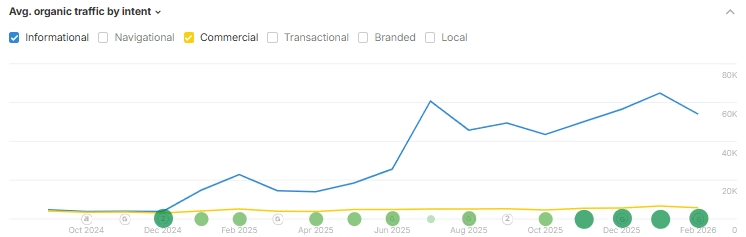
Informational (TOFU) vs. commercial-intent organic traffic for a wellness coaching client, Aug 2024-Feb 2026. Source data anonymized at the client’s own dashboard level.
What Is TOFU Marketing?
TOFU stands for “top of funnel” the awareness stage of the customer journey, before a prospect has compared options or even fully named their problem. Marketing funnels split the journey into three main stages:
- TOFU (Awareness): the prospect realizes they have a problem. Your job is to educate, not sell.
- MOFU (Consideration): the prospect actively compares solutions.
- BOFU (Decision): the prospect is ready to buy, and your job is to make the case for you specifically.
TOFU content works when it helps someone understand their situation better, with no ask attached.
A blog post that explains a problem, a social video that’s genuinely useful, a PR placement that puts your name next to a topic your audience already cares about all TOFU.
A discount code or a demo request is not.
TOFU vs. MOFU vs. BOFU: Quick Comparison
| Stage | Goal | Content Type | Primary Metric |
|---|---|---|---|
| TOFU | Build awareness | Blog posts, social content, PR, display ads | Reach, impressions, engagement |
| MOFU | Drive consideration | Comparison guides, webinars, case studies | Email opt-ins, content downloads |
| BOFU | Close the decision | Demos, pricing pages, testimonials | Conversion rate, sales qualified leads |
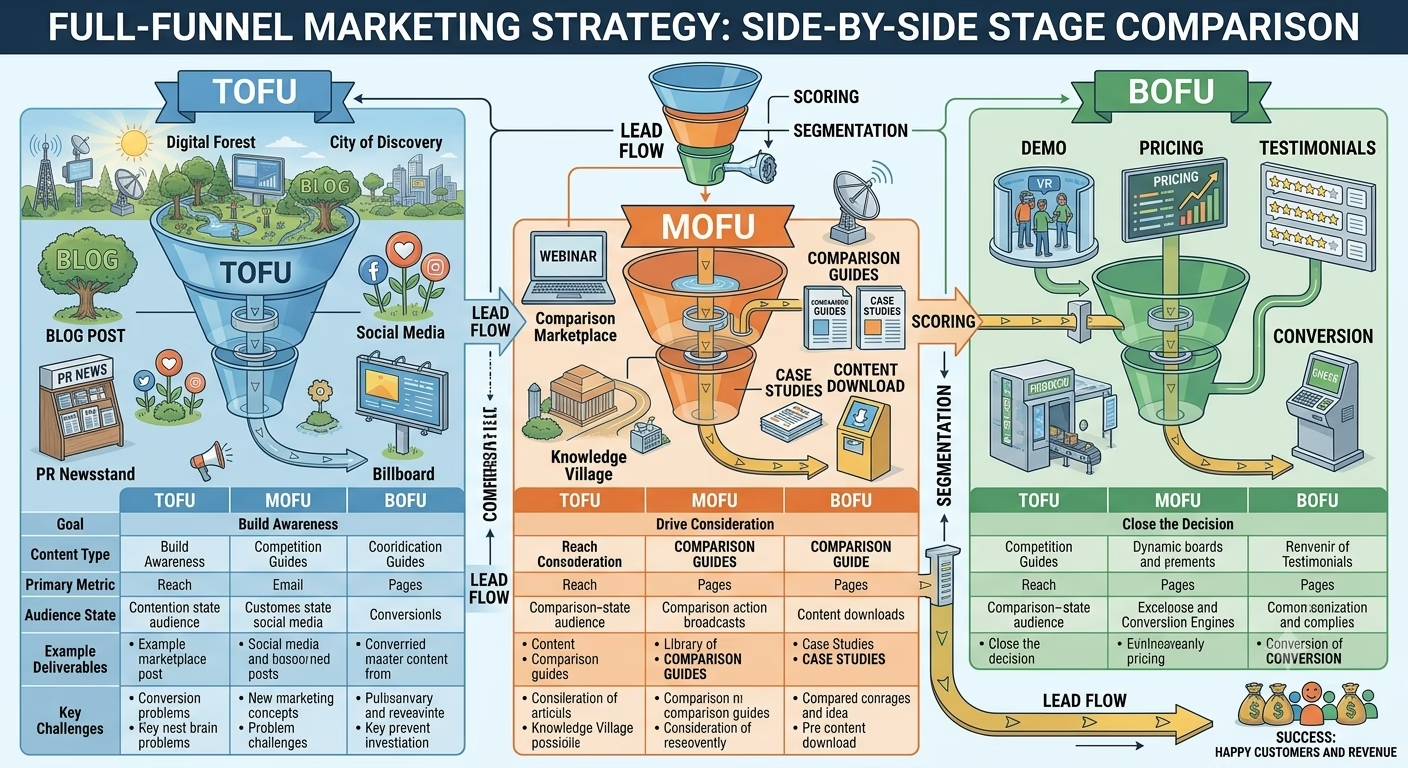
Pull the wrong metric into the wrong stage and you’ll misjudge a campaign that’s working. A TOFU blog post with a 0.3% conversion rate and 40,000 monthly readers isn’t underperforming — it’s doing exactly what TOFU content is supposed to do.
7 Best TOFU Marketing Activities for Awareness Campaigns
Every list of TOFU tactics looks roughly the same: content, social, ads, PR, influencers. The part most guides skip is when each one actually earns its budget. Here’s that breakdown.
Don’t run all seven at once, especially with a small team. Two questions narrow it down fast: does your audience have a strong offline or event presence (dental, plumbing, moving, local services lean yes), and do you have any budget for paid reach right now, or only time. A local service business with no ad budget starts with SEO, organic social, and referral. A funded SaaS company launching in a new market leans harder into paid social, PR, and influencer partnerships, because time is the scarcer resource, not money.
1. SEO and Content Marketing
Write for the questions your prospects are asking before they know your product exists — not your product’s features. Someone searching “how to reduce no-shows at a dental practice” isn’t ready to book a demo of your scheduling software. They’re ready to read something useful about the problem.
Start with informational-intent keywords, not commercial ones. Run your topic ideas through a keyword search intent identifier before you write, so you’re not building a BOFU page for a TOFU query. For topic expansion beyond your first idea, a keyword generator will surface the adjacent questions people actually type.
When to use it: you have 6+ months of runway before you need results. SEO compounds, but it doesn’t move fast. What to track: organic traffic, ranking positions for informational terms, time on page.
2. Organic Social Media
Pick one or two platforms where your audience actually spends time, not every platform that exists. A plumbing company’s audience isn’t on the same platform, at the same time, for the same reasons, as a SaaS buyer’s audience.
Organic social is where you test messaging cheaply before you put money behind it. If a post about a specific pain point gets shared and commented on, that’s a signal worth acting on. If it gets impressions and nothing else, that’s a signal too.
Before you publish, run your headline or hook through a headline analyzer — the difference between a post that stops the scroll and one that doesn’t is often the first seven words.
When to use it: always, in some form, once you know where your audience is. What to track: engagement rate (not follower count), shares, comments.
3. Paid Social and Display Advertising
Paid buys you reach on a timeline organic can’t match. It’s the right move when you need awareness now — a launch, a seasonal push, a new market — not when you’re still figuring out what your audience responds to.
Before you commit budget, run your numbers through a CPM calculator to know what reach actually costs at your target volume, and a CTR calculator to set a realistic benchmark for your creative. If your projected ROAS doesn’t work at TOFU-stage conversion rates, use a ROAS calculator to model it before you spend, not after.
When to use it: you need reach faster than organic can deliver, and you have creative that isn’t a direct pitch. What to track: CPM, CTR, frequency (watch for ad fatigue past 3-4x).
4. Digital PR and Media Outreach
Getting your name or your data in front of a journalist, an industry blogger, or a niche publication does two things at once: it builds awareness with an audience you don’t own, and it earns a backlink that helps your SEO. Original research, a data-driven study, or a genuinely useful expert take are the three things that get picked up. A product announcement usually doesn’t.
If you’re building outreach lists or need to understand where your domain authority currently stands before you pitch, check where high-DA opportunities exist and review off-page SEO strategies that pair naturally with a PR push.
When to use it: you have something genuinely newsworthy — data, a contrarian take, a study — not just an announcement. What to track: backlinks earned, referral traffic, brand mentions.
5. Influencer and Podcast Partnerships
You’re borrowing trust that took someone else years to build. That only works if the fit is obvious to their audience — a mismatched partnership reads as an ad, and their audience will treat it like one.
Podcast sponsorships work particularly well for TOFU because the format rewards a longer, more conversational pitch than a 15-second video ad allows. Give the host room to talk about you in their own words instead of reading a script.
When to use it: you’ve identified a specific community whose trust you want to borrow, and you can find a partner whose audience overlaps with yours without competing with you directly. What to track: referral traffic with UTM tracking, branded search lift during and after the campaign.
6. Referral and Word-of-Mouth Programs
Once you have any customers, they’re your cheapest awareness channel. A referral program that makes sharing easy — a link, a code, a simple invite — turns existing trust into new awareness without an ad budget behind it.
This works even for TOFU-stage traffic if your referral mechanic rewards sharing content, not just direct signups. A shared blog post or shared tool still counts as top-of-funnel exposure for the person on the receiving end. If you’re weighing referral against other acquisition-adjacent channels, this breakdown of affiliate marketing’s advantages covers the tradeoffs between owned referral programs and paid affiliate structures.
When to use it: you have an existing customer or user base, however small. What to track: referral volume, share rate, cost per acquired lead relative to paid channels.
7. Community, Events, and Offline Reach
Digital out-of-home ads, local sponsorships, meetups, and industry events reach people who aren’t scrolling — and for local-service businesses especially (dental, plumbing, moving, jewelry), offline is often where the audience actually is. A moving company sponsoring a local community event reaches the exact radius of people who’ll need movers in the next two years, at a cost per impression that undercuts most digital display buys in that same zip code. These channels get overlooked because they’re harder to track precisely, not because they don’t work.
The tracking problem has a workaround: use a dedicated phone number or a short branded URL for each offline placement, and check for a lift in branded search volume in that geography during and after the campaign window. It’s not as clean as a UTM link, but it’s enough to tell whether the spend did anything.
When to use it: your audience is local, or your category has a strong in-person community (industry conferences, trade shows). What to track: branded search lift in the target geography, direct traffic spikes tied to event dates.
How to Measure TOFU Success
Match the metric to the tactic. A generic “track engagement” instruction doesn’t tell you what to do when the numbers come in.
| Tactic | Primary Metric | Secondary Metric |
|---|---|---|
| SEO & Content | Organic traffic, keyword rankings | Time on page, scroll depth |
| Organic Social | Engagement rate | Shares, saves |
| Paid Social & Display | CPM, CTR | Frequency, video completion rate |
| Digital PR | Backlinks, referral traffic | Brand mentions |
| Influencer/Podcast | Branded search lift | UTM-tracked referral traffic |
| Referral/WOM | Referral volume | Cost per acquired lead |
| Community/Offline | Branded search lift (geo) | Direct traffic spikes |
Two numbers worth watching across every tactic: branded search volume (are more people searching your company name after a campaign?) and share of voice against competitors. Both tell you whether awareness is actually landing, independent of any single channel’s reporting dashboard.
For anything involving paid spend, revisit your customer lifetime value calculation before setting a target cost-per-lead. A TOFU lead that costs $40 to acquire looks expensive in isolation and reasonable once you know what that customer is worth over time.
How Much Budget Should TOFU Get? (The 70/20/10 Rule)
The 70/20/10 rule is the most common framework for splitting a TOFU budget:
- 70% goes to tactics you already know work for your audience — the channel that’s produced awareness before.
- 20% goes to adjacent experiments — a new platform, a new content format, a variation on a proven tactic.
- 10% goes to high-risk, high-upside bets — an unproven channel, an experimental partnership, something that might not work at all.
Early-stage teams with no track record yet should weight this differently: closer to 60% proven-adjacent tactics (content and SEO, which are low-cost to start) and more into the 20-30% experimental range, since “proven” doesn’t exist for you yet. As you gather data on what actually drives branded search lift and qualified traffic, shift back toward the standard 70/20/10 split.
Common TOFU Mistakes to Avoid
Judging TOFU content by BOFU metrics. A blog post’s job is reach and education, not conversion rate. If you’re killing content because it doesn’t convert like a landing page, you’re using the wrong yardstick.
Running every platform at once. Three platforms at 30% effort loses to one platform at 100% effort. Pick where your audience actually is before you spread out.
Skipping the outreach step in PR. Publishing a study and waiting for journalists to find it doesn’t work. The outreach — the actual pitch to specific people — is the part that gets coverage, not the content itself.
No UTM tracking on influencer or PR placements. Without tracking, you can’t tell whether a spike in traffic came from the partnership or from something else entirely. Tag everything before it goes live, not after.
Treating a launch spike as a trend. A PR hit or an influencer post can double your traffic for three days and then flatten out completely. That’s a real result, not a failure — but if you build next quarter’s plan assuming that traffic level continues, you’ll overcommit budget against numbers that were never going to hold.
Writing TOFU content in BOFU language. A blog post titled “Why [Your Product] Is the Best Choice for X” is bottom-funnel copy wearing a blog-post costume. Someone at the awareness stage doesn’t know your product category exists yet, let alone that you’re the best option in it. Match the language to where the reader actually is.
FAQ
What is the top of the funnel in marketing? It’s the awareness stage — the point where a prospect first encounters your brand or realizes they have a problem, before they’ve compared solutions or considered buying anything.
What are upper-funnel tactics? Upper-funnel tactics are the same as TOFU tactics: content marketing, SEO, organic and paid social, PR, and influencer partnerships aimed at building broad awareness rather than driving immediate conversions.
What is the 70/20/10 rule in marketing? A budget-allocation framework for TOFU spend: 70% on tactics with a proven track record, 20% on adjacent experiments, and 10% on high-risk, unproven bets.
How is TOFU different from lead generation? TOFU builds awareness with people who may not yet know they have a problem. Lead generation typically targets people further along — those actively researching or ready to hand over contact information. TOFU feeds lead generation; it isn’t the same activity.
What metrics matter most for TOFU campaigns? Reach, engagement rate, branded search lift, and share of voice against competitors. Conversion rate and cost-per-acquisition belong to later funnel stages, not TOFU.

Mansoor Bhanpurawala is the founder of DigitalMansoor.com. With 20K+ followers on LinkedIn, he has been doing SEO since 2012 and, with over 14 years of experience, has helped 600+ clients across multiple industries build sustainable online growth.
With consulting, he enjoys sharing beginner-friendly guides to help others start and scale their blogs and brands. He’s grown client traffic up to 50X and revenue up to 240X. Helped multiple clients get mentions on TOI, Forbes, Mint, etc.

Leave a Comment