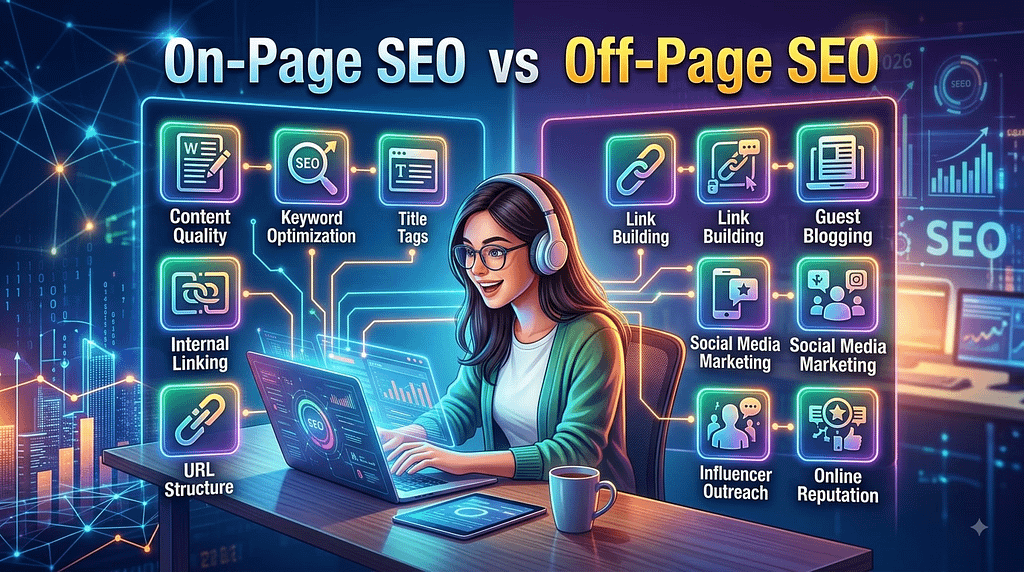
Most beginners hear “on-page SEO” and “off-page SEO” used interchangeably with “SEO” itself, then spend months optimizing one while ignoring the other completely. That split matters more than it sounds like it should, because the two categories answer two different questions Google asks about your page: can I understand and trust what’s written here, and does the rest of the internet agree this page is worth showing people.
This guide breaks down what each category actually covers, which one deserves your time first, and where beginners typically get the split wrong.
TL;DR
- On-page SEO is everything you control directly on your own pages: title tags, headings, content quality, internal links, and site structure.
- Off-page SEO is everything that happens away from your site that still signals trust to Google: backlinks, brand mentions, reviews, and social proof.
- Google’s own SEO Starter Guide confirms both matter. On-page elements help Google understand and rank your content, and links from other sites are described as “a crucial resource” for discovery and trust.
- Neither substitutes for the other. Strong on-page work with zero outside signals plateaus. Backlinks pointed at thin, poorly structured pages waste the authority you spent time earning.
- For most sites without an existing authority base, on-page SEO is the higher-return starting point. It’s fully within your control, and it’s what makes any backlink you earn later actually convert into a ranking.
What is on-page SEO?
On-page SEO covers every optimization you make directly on a page you own; the elements Google reads when it crawls that specific URL. That includes your title tag, H1 and subheadings, body content, image alt text, internal links, URL structure, and page speed.
The defining trait of on-page SEO is control. You don’t need anyone’s permission to fix a weak title tag or restructure your headings. If a page isn’t ranking and the problem is on-page, you can find it and fix it today.
What is off-page SEO?
Off-page SEO covers signals that happen away from your own website but still tell Google (and increasingly, AI search systems) that your site is worth trusting. The core off-page signal is backlinks, other websites linking to yours. Beyond links, off-page SEO also includes brand mentions without a link, reviews, social proof, and how often people search your brand name directly.
The defining trait of off-page SEO is that you don’t fully control it. You can create something worth linking to, and you can ask for a link, but the decision to actually link back sits with someone else’s website.
What’s the real difference between on-page and off-page SEO?
The split comes down to location and control, not importance. One happens on your domain, and you own the fix. The other happens on someone else’s domain and you can only influence the outcome.
| On-page SEO | Off-page SEO | |
|---|---|---|
| Where it happens | On your own pages | On other websites, search results, and social platforms |
| Who controls it | You, directly | Partially you, mostly other site owners and users |
| Core signals | Title tags, headings, content, internal links, page speed, structured data | Backlinks, brand mentions, reviews, social signals |
| Time to see results | Faster, since fixes go live immediately | Slower, since it depends on other people acting |
| Main risk of doing it wrong | Keyword stuffing, thin content, duplicate titles | Spammy or paid links, fake reviews, link schemes |
Which matters more, on-page or off-page SEO?
Neither wins outright, but the order you tackle them in matters. On-page SEO is the foundation: a page with a confusing structure, thin content, or a missing title tag won’t rank no matter how many backlinks point at it. Off-page SEO is the amplifier: it moves a well-built page higher and faster than on-page work alone ever could, but it has nothing to amplify if the page underneath it is weak.
If you’re starting from close to zero, put your time into on-page SEO first. It’s free, it’s within your control, and it’s the checklist that determines whether any link you later earn actually does something for you. Once your pages are solid, off-page work is what closes the gap against competitors who are already well optimized on-page.
For local and service businesses specifically, this split also shows up in how “old-school” ranking tactics have aged. Some once-standard off-page moves no longer work the way they used to; it’s worth comparing old SEO with new SEO before you build a strategy around a tactic that peaked a decade ago.
On-page SEO checklist: what to fix on your own pages
Start here, in roughly this order:
Title tags: Each page needs a unique, specific title that describes exactly what’s on the page. This is consistently the on-page element that carries the most weight; the full breakdown of why, along with the other six factors that matter most, is in which on-page element carries the most weight for SEO.
Keyword targeting, done from research, not guessing: Pick one primary keyword per page based on actual search demand and difficulty, not the phrase that sounds right in your head. Compare tools in 9 best keyword research tools for SEO if you haven’t settled on one yet.
Content that actually answers the query: Depth matters less than completeness. A page that fully answers the searcher’s question in 800 words will outperform a padded 2,000-word page that circles the topic without landing on it.
Header structure: One H1, logical H2s that map to subtopics, and H3s only when a section genuinely needs further breakdown. This is also what makes your content easier for AI answer engines to extract and cite.
Keyword density, checked, not chased: Once your draft is done, run it against your target keyword to catch both under-optimization and stuffing. The keyword density checker does this in under a minute.
Internal links: Every page should link to at least a few related pages on your own site, using descriptive anchor text rather than “click here.” This also helps you pass authority from stronger pages to newer ones.
Structured data: Adding schema markup doesn’t move rankings by itself, but it does make your page eligible for rich results. The schema markup generator covers 12 schema types if you’re adding this for the first time.
Off-page SEO checklist: building authority away from your site
Off-page SEO in 2026 looks different from the directory-submission playbook that worked a decade ago. Most of what still moves the needle now depends on things worth linking to, not links you manually place.
Digital PR and linkable assets. Original data, tools, or research that journalists and bloggers reference naturally earns links you can’t manufacture through outreach alone.
Broken link building and unlinked mention reclamation. Both are lower-effort, higher-success-rate tactics than cold outreach, since you’re asking for something the site owner already has a reason to fix.
Guest contributions and community participation, done for relationships and visibility rather than as a link-quantity play.
Profile and citation building on high-authority platforms. These won’t carry the weight of an editorial link, but they contribute to entity trust and brand consistency signals. A categorized list of where to start is in 300+ high-DA profile creation sites.
For the complete ranked list of what still works versus what’s dead weight, see off-page SEO strategies that still work in 2026, including the specific directory and web 2.0 tactics worth dropping entirely.
How do on-page and off-page SEO work together?
They compound rather than operate independently. A backlink pointing to a page with a vague title, thin content, and no internal links passes some authority, but that page still won’t rank well, because the on-page signals tell Google the page doesn’t deserve the traffic the link is sending it. Conversely, a page with excellent on-page optimization but zero external signals tends to plateau below page one for anything moderately competitive, since Google still uses off-page trust signals to break ties between similarly well-optimized pages.
The practical sequence: fix on-page first so the page is worth linking to, then invest in off-page so people (and Google) find out it exists.
Common mistakes to avoid
The most common on-page mistake is optimizing for the keyword instead of the searcher, stuffing a phrase into headings and body copy at the expense of actually answering the question. The most common off-page mistake is chasing link volume over link relevance, buying or trading links from unrelated, low-quality sites that do more reputational damage than ranking good.
Both mistakes fall into the same trap: optimizing for what you think the algorithm wants rather than what a real visitor needs. If you’re unsure whether a specific tactic on either side crosses the line, run it through the framework in black hat SEO vs white hat SEO: would you comfortably explain this tactic to a Google engineer.
FAQs
Is on-page SEO more important than off-page SEO?
Not more important, but it comes first. On-page SEO determines whether a page deserves to rank; off-page SEO determines how far it ranks once it’s competitive. Skipping on-page work makes off-page effort far less effective.
Can I rank with only on-page SEO and no backlinks?
For low-competition, long-tail keywords, yes, often. For anything with real competition, on-page SEO alone typically plateaus below page one, since competitors with comparable on-page quality plus backlinks will outrank you.
How long does off-page SEO take to show results?
Longer than on-page fixes, usually months rather than days, since it depends on other sites choosing to link, mention, or cite you. On-page changes can affect rankings within days to a few weeks once Google recrawls the page.
Do social media shares count as off-page SEO?
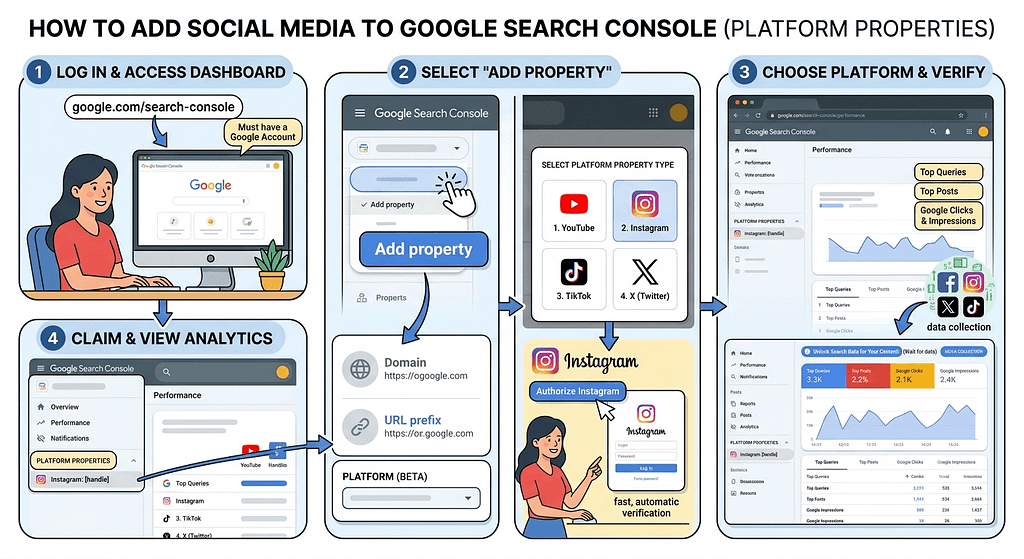
Social shares aren’t a direct Google ranking factor, but they contribute to off-page SEO indirectly by increasing the odds that someone who sees the content links to it from their own site or blog.
What’s the single highest-leverage on-page fix for a beginner?
Title tags. They’re read by users deciding whether to click and by Google when it decides what a page is about, so a weak or duplicate title is one of the costliest on-page mistakes to leave unfixed.

Mansoor Bhanpurawala is the founder of DigitalMansoor.com. With 20K+ followers on LinkedIn, he has been doing SEO since 2012 and, with over 14 years of experience, has helped 600+ clients across multiple industries build sustainable online growth.
With consulting, he enjoys sharing beginner-friendly guides to help others start and scale their blogs and brands. He’s grown client traffic up to 50X and revenue up to 240X. Helped multiple clients get mentions on TOI, Forbes, Mint, etc.
Leave a Comment