Last updated on November 16th, 2026 at 01:12 pm
Google publishes a list of its ranking systems, and the list has no entry called topical authority. It names systems for PageRank, passage ranking, original content, reviews, freshness and a few more. The closest match is a news-focused system for surfacing local sources.
Topical authority is a label SEOs invented for something real, and the label hides more than it explains. This guide separates the useful idea from the marketing around it, then lays out how to build the useful part.
What Google lists, and what it doesn’t
The ranking systems guide names BERT, deduplication systems, freshness systems, link analysis systems and PageRank, local news systems, MUM, neural matching, original content systems, the passage ranking system, RankBrain, reliable information systems, the reviews system, a site diversity system and spam detection systems, among others. No “topic authority” system appears. The page notes that the helpful content system became part of Google’s core ranking systems in March 2024.
Google did describe a ranking system named topic authority in a 2023 post about news. Search Engine Roundtable’s write-up quotes its aim as surfacing relevant, expert and knowledgeable content in Google Search and News. That is a news feature, not a general site score.
On the broader idea of a site-wide authority number, Google’s Gary Illyes said Google doesn’t really have overall domain authority, as Search Engine Roundtable reported. John Mueller said much the same about a website authority score.
And on topical authority specifically, Mueller affirmed a Redditor’s view that the phrase is mostly a new label for relevance. Search Engine Journal’s account of the exchange reports that he advised not to worry about it. In that telling, it’s fine to say a site has topical authority because it ranks well, but the claim gets shaky when people present it as a revolutionary tactic.
What SEOs mean by the term
Three different claims hide under one phrase.
The first says that sites covering a subject thoroughly tend to rank better on that subject than sites that touch it once. This claim is plausible and consistent with how Google describes its own guidance.
The second says Google computes a topical authority score per site. Nothing in Google’s documentation supports that, and I’ve seen no primary source for it. Claims built on the 2024 documentation leak come from third parties interpreting leaked material, so treat them as theories.
The third says you can build a score by publishing a cluster of N articles. That’s the claim vendors sell, and it’s the weakest of the three, since no source shows a specific number of pages produces a specific result.
My working definition is narrow: topical authority is the practical result of a focused site that covers a subject completely, links its pages sensibly and earns trust from other sources. You observe it after pages rank. Nobody can pull it like a lever.
Why the underlying idea still holds
Google’s guidance on helpful content asks whether your site has a primary purpose or focus. That’s about as close as Google’s documentation comes to this topic. A site with a clear subject is easier to classify, easier for a visitor to trust and easier to link internally.
Coverage helps for a mechanical reason too. Google’s AI features may split a question into several related searches and pull pages for each, as its AI features documentation describes. A site with a strong page for each sub-question has more chances to be pulled in than a site with one page that mentions them all.
Still, keep the claim modest. Links remain a named system in Google’s list (link analysis systems and PageRank), so thorough coverage doesn’t replace earning links. A new site with excellent coverage and no links will usually still struggle against established sites on competitive terms. I can’t give you a threshold, because Google doesn’t publish one.
How to build it in practice
Start by drawing a boundary. Decide the subject you want to be known for in one sentence, narrow enough that you could realistically cover it. “SEO” is too wide for one small site. “Technical SEO audits for Indian ecommerce stores” is closer to a boundary.
List the questions a buyer asks across the whole decision. Pull them from Search Console queries, People Also Ask boxes, sales conversations and support emails. Group them by intent: learning the basics, comparing options, choosing a provider, solving a specific problem.
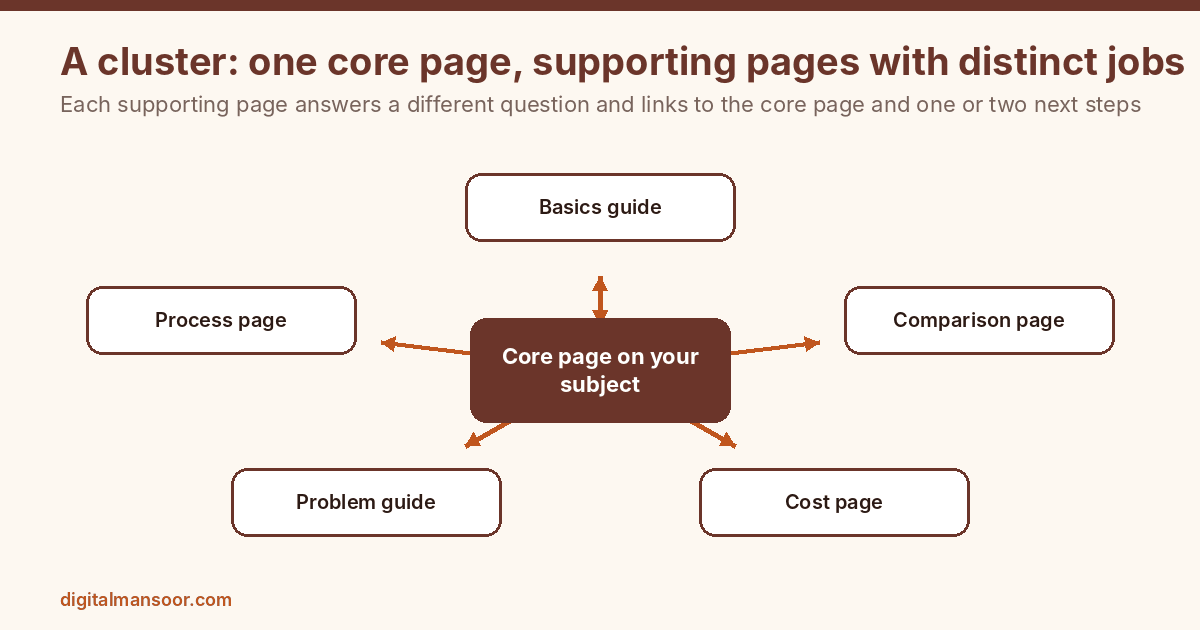
Then assign one page per distinct intent. This is the step most clusters skip. If two questions would be answered by the same page, they get one page. Splitting them gives you two thin pages that compete, and that’s where keyword cannibalization starts.
Write the core page first. A strong main page on the central topic gives you something to link everything else to. Publish supporting pages in order of business value, not alphabetically: the pages closest to a purchase decision usually come before the basics.
Link deliberately. Each supporting page should link up to the core page and across to the one or two pages a reader would want next, using anchor text that describes the destination. Link from the core page back down to each supporting page. A page nobody links to is a page that Google, and your readers, are unlikely to find.
Add something only you can add to every page. Original numbers, first-hand process, real screenshots. Google’s optimization guidance pushes non-commodity content, and a cluster made of commodity pages is only a bigger pile of commodity.
What a useful cluster looks like next to a thin one
Take a site that sells GST filing help to small businesses in India. A thin cluster has twenty articles with titles like “What is GST”, “GST meaning”, “GST full form” and “GST explained”. They answer one question twenty ways, and any of them could replace the others.
A useful cluster has one page on the basics, then separate pages for the questions a small business owner has at different moments. How to pick a filing frequency. What to do after a notice arrives. How to fix a mismatch between sales records and the return. Each page serves a different person at a different point, so each earns its place. The example is illustrative, not a case study.
The test is simple. Cover each page with your thumb and read only the headline. If you can’t say who needs that page and when, the page probably doesn’t belong.
Original content still counts
Google’s ranking systems guide lists original content systems among its named systems. Coverage built from rewritten versions of what already ranks gives those systems nothing to reward. You can cover every subtopic on a list and still add no information the searcher couldn’t already find.
Original can be modest. Your own process, a table from your own data, a screenshot from a real project, a decision rule you use with clients. Pull one such element into every supporting page. If you have no first-hand material for a topic, that’s a signal to skip the topic or interview someone who does.
How many pages is enough?
No source gives a number, and any article that does is guessing. Use a stopping rule instead: keep adding pages while each new one answers a distinct question that a real person asks and that your existing pages don’t answer. Stop when the next topic would repeat something you already cover.
For a service business, that’s often a modest set. A page for each major service, a handful of guides on the problems buyers face before they hire, and a few comparison or cost pages may cover the subject. A publisher with a broad beat needs far more.
Where clusters go wrong
Publishing for the map instead of the reader. A spreadsheet full of keywords turned into 80 thin articles is the standard failure. Google’s spam policies describe scaled content abuse as many pages generated primarily to manipulate rankings without helping users, and they apply no matter how the pages are made. A cluster built for volume sits uncomfortably close to that line.
Orphaned spokes. If supporting articles don’t link to each other and to the hub, you’ve published a list, not a cluster.
Chasing queries that don’t fit the business. Traffic from topics your buyers don’t care about builds a content library, not an audience.
Judging the work by a third-party authority score. Those scores come from tools, and as noted above, Google doesn’t use an overall domain authority. They can help you compare sites, but they can’t tell you whether your coverage is working.
Forgetting maintenance. A cluster of outdated pages signals the opposite of expertise. Review key pages on a schedule and update facts that have changed.
Internal links carry more of the load than most clusters admit
Internal links tell Google which pages matter and how they relate. Google’s SEO starter guide recommends descriptive anchor text for links, so “GST notice reply steps” tells the crawler more than “click here” does.
Check three things on every cluster page. It has at least one link in from the hub. It links out to the next logical page. The anchor text describes the target. Run a crawl with Screaming Frog or a similar tool and list pages with zero inbound internal links. Those are your orphans, and they are the first thing to fix before you publish anything new.
Avoid stuffing a page with twenty links to every sibling. A reader needs the two or three that come next, and a long block of links dilutes all of them.
How to measure progress
Measure the group of pages, not individual ones. In Search Console, filter the Performance report by a URL pattern or folder that contains the cluster. Track four numbers over time: impressions, clicks, average position, and the count of pages indexed from the folder.
If impressions rise across many of the pages together, coverage is working. If one page rises and the rest sit still, look at internal links and content depth for the laggards. If pages stay out of the index, go to your indexing report first, because coverage that Google doesn’t index does nothing.
Also track conversions or enquiries from the cluster, since traffic that never turns into business is a vanity metric. Compare the cluster against a similar group of pages you haven’t touched, if you have one, to separate your work from general trends.
Give it time. Google doesn’t publish a timeline, and neither will I.
Quick answers
Is topical authority a ranking factor?
Google doesn’t list it as one. Its ranking systems guide has no topical authority system, and Mueller has told SEOs not to worry about the term. The practices behind it, such as focus, coverage and internal linking, are still good practice.
Does it matter for AI search?
Google says its AI features may run several related searches and pull pages for each, so coverage of sub-questions can help. Whether other AI engines reward it is unproven.
Can a small site build it?
A small site can cover a narrow subject well. That’s usually a better bet than competing on a broad one. Expect it to take time and to still need links.
What to do first
Write your one-sentence subject boundary, then list ten questions buyers ask. Check which already have a good answer on your site. The gaps in that list are your next articles, in order of how close they sit to a sale. For a full content plan built around your services, see my content strategy SEO consulting page.
Leave a Reply