Last updated on November 16th, 2026 at 01:13 pm
YMYL is not a ranking factor. Google’s own page on helpful content says E-E-A-T itself isn’t a specific ranking factor, and the term YMYL (Your Money or Your Life) comes from the guidelines Google gives its human quality raters, not from a setting in the ranking system. What it does describe is a set of topics where Google says it wants content that is highly accurate and consistent with expert consensus.
If your site sells insurance, accounting, legal or medical services, YMYL applies to you. This article explains what Google actually says, what a YMYL site should show on every page, and where Indian regulators add rules that Google’s guidance never mentions. I am not a lawyer, and the regulatory sections are a map to check against the primary text, not legal advice.
What YMYL means
Google’s helpful content page describes YMYL as topics that could significantly affect people’s health, finances or safety. It says Google’s systems give even more weight to content that aligns with strong E-E-A-T for these topics, and that such content must be highly accurate and consistent with established expert consensus.
The Search Quality Rater Guidelines carry the detailed definition. According to ppc.land’s summary, it sits in section 2.3 of the guidelines, in the September 11, 2025 edition, which runs 182 pages. The categories are health or safety, financial security, government, civics and society, and a residual group. The September 2025 edition renamed the society category and named election and voting information explicitly.
I read these details through secondary coverage, not the PDF itself. Raters don’t change rankings directly. Third-party summaries describe their ratings as feedback used to evaluate Google’s systems. Read the current PDF before you quote any section number.
What E-E-A-T gets wrong in most explanations
E-E-A-T stands for experience, expertise, authoritativeness and trust. Google’s page says trust is the most important of these. Experience, expertise and authority support trust, and content doesn’t need all three. Google also says E-E-A-T isn’t a direct ranking factor, and that its systems use a mix of signals to identify content that shows it.
So there is no E-E-A-T score to raise. The practical question is narrower: can a visitor and a reviewer tell who wrote this, why they’re qualified, how the content was made and whether it’s safe to act on? That’s the part you can fix.
Google also gives a Who, How and Why test. Who created the content, and is that clear on the page? How was it created, and is that disclosed where readers would ask, especially for automated or AI-assisted content? Why was it created? Google calls that the most important question and says content should be made primarily to help people.
Why this hits Indian professional sites harder
A health, insurance or tax page can be wrong in ways that cost people money or harm. Two things make Indian sites in these fields exposed.
First, thin copy is everywhere. A page that lists “10 benefits of term insurance” with no named author, no date and no source reads like every other page. It has nothing to show it was written by someone who knows.
Second, regulators in India limit what you can claim. A page can satisfy Google and still breach a rule from the insurance or accounting body. The sections below cover those two cases.
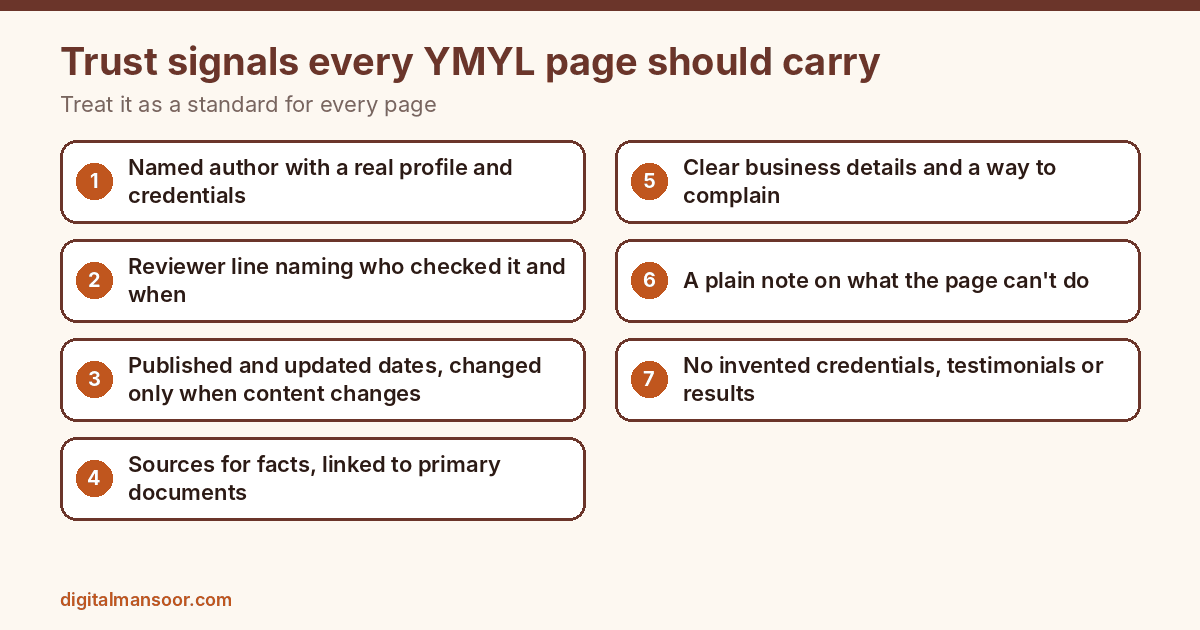
The trust signals every YMYL page should carry
Treat this list as a standard for every page, not a one-time project.
- A named author with a real profile page that states qualifications and registration numbers where they exist. Google “strongly encourages” accurate authorship information, and says bylines should be easy to find and link to author background.
- A reviewer line on medical, legal, tax and insurance content, naming who checked it and when. Keep it truthful. Google warns that fabricated creator profiles make a page untrustworthy.
- A visible published and updated date, changed only when the content changes.
- Sources for facts: the law, the circular, the study. Link to the primary document where one exists.
- Clear business information: a real address, phone number, registration details and a way to complain.
- A plain statement of what the page can’t do, such as general information, not advice for your case.
- No invented credentials, testimonials or case results.
Check your bylines with the E-E-A-T author bio score checker, a free tool on this site. It scores on signals a visitor can see. It can’t tell you how Google values any of them.
Insurance sites: regulation sits on top of SEO
For insurance, IRDAI rules matter as much as search guidance. The IRDAI (Protection of Policyholders’ Interests, Operations and Allied Matters of Insurers) Regulations, 2024 took effect on April 1, 2024. Law-firm summaries say they replaced the older IRDAI advertisement regulations and a 2019 master circular, and spread the advertising norms across the 2024 regulations and several master circulars.
Reporting on the June 2024 circulars says IRDAI barred unit-linked and index-linked products from being advertised as investment products, and required insurers to have an advertisement committee or a senior officer review ads. Intermediaries are covered too, according to the Mondaq analysis I read.
For an SEO writer, this has practical consequences. Don’t call a ULIP an investment on a landing page without checking the current text. Don’t use guaranteed-return language. Don’t present a comparison table that ranks products in a way a regulator could call misleading. Policybazaar’s penalty over misleading display and ranking of products, reported by TaxGuru, shows the regulator looks at presentation, not only wording.
Have the insurer’s or distributor’s compliance officer approve copy before it goes live, and keep the approval. If you work as an intermediary, ask which circular governs your category. See my insurance SEO consultant page for how I handle this in client work.
Accounting sites: the ICAI position changed in 2026
For chartered accountants, the rules moved recently. The ICAI’s Council approved amendments to the advertisement and website guidelines on December 12, 2025, according to its press release. The revised 13th Edition of the Code of Ethics applies from April 1, 2026, per the Ethical Standards Board announcement reproduced by TaxHeal.
Secondary sources say the change lets CA firms advertise and expands website features such as push technology for services that aren’t exclusive to the profession. The ICAI’s own “Know Your Ethics” column in the August 2026 CA Journal says members may mention peer review status on a firm website, and may run webinars and invite non-clients. The same column addresses online aggregator listings. The excerpt I could read was cut off, so check the full answer before you list a firm on any directory or aggregator platform.
Guidance from the Institute also still contains conditions on the content of write-ups. I couldn’t read the clause text itself, so I won’t summarise its limits here. Open Volume I of the Code of Ethics 2026 on the ICAI site, and read the advertisement and website guidelines before you publish a firm website or a service page. My accounting SEO consultant page covers what I do within those limits.
Law and healthcare
Lawyers and doctors in India face their own advertising restrictions through the Bar Council of India and the medical regulator. I have not verified the current text of either, so I won’t summarise it. Check the latest rules with the regulator or your professional body before you publish case results, patient stories or testimonials. My pages on law firm SEO and healthcare SEO describe the service side.
A before and after on one page
This example is hypothetical. A Surat accounting firm has a page titled “GST notice reply”. The original has no author, no date, three paragraphs of general text and a line saying “we guarantee a favourable outcome”.
The revised page names the CA who wrote it with their membership details, names a second CA who reviewed it and shows the date of the last review. It explains the main types of notice, links to the relevant government pages, lists the documents a firm usually needs and states that each case differs. The guarantee line is gone. A visitor can now see who stands behind the page, and the claim no longer risks a conflict with the firm’s professional rules.
What to publish, and what to leave out
Write pages that answer a real question and stop where your expertise stops. A tax page can explain how a notice works and what documents matter. It shouldn’t tell a visitor what to do in their particular case.
Leave out claims you can’t prove: “best”, “guaranteed”, “100% approval”. Leave out any content that you or your reviewer can’t stand behind. A short, accurate page beats a long one with a doubtful section.
Update pages when the law, the premium rules or the filing deadline changes. A visible updated date helps only if it’s real. When a rule changes, the old page should say what changed, not silently rewrite history.
AI-written drafts on YMYL topics
Google’s helpful content page suggests disclosing AI or automation where readers would reasonably ask how content was made. For YMYL pages, a draft from a tool is a starting point and not a finished page. A qualified person has to read it, correct it and put their name to it.
Don’t let a tool generate hundreds of pages across insurance or tax topics at once. That pattern also sits close to Google’s scaled content abuse policy, and on these topics a wrong answer carries a higher cost than on a recipe blog.
Quick answers
Is YMYL a ranking factor?
Google says E-E-A-T isn’t a specific ranking factor, and YMYL comes from the rater guidelines. Google does say its systems give more weight to strong E-E-A-T on topics that could affect health, finances or safety.
Do I need credentials to rank in these niches?
Google doesn’t publish a requirement. It does say trust matters most and asks whether readers can tell who wrote the content.
Does having a doctor or CA write the content guarantee rankings?
I found no source that supports that. A qualified author helps a visitor trust the page, but links, relevance and quality all still count.
Where to start
Open your five highest-traffic pages. For each, check the byline, the reviewer, the date, the sources and the regulator’s rules. Fix the page with the most traffic and the weakest answer to those five first.
Leave a Reply