You search your best keyword and a competitor’s paragraph sits in a box above every result, yours included. That box is the target of answer engine optimization.
So, what is answer engine optimization? AEO is the practice of writing and structuring a page so a search engine can lift one clear answer out of it and show that answer directly, in a featured snippet, a People Also Ask entry or a spoken reply from a voice assistant. The page still has to rank and still has to be indexed. AEO adds a formatting and wording job on top of that.
Many guides stretch the term until it covers everything. I’d rather keep it narrow, because a narrow version is the only one you can test.
Why every AEO definition disagrees
Read five AEO guides and you get five scopes. IONOS lists featured snippets, People Also Ask, voice assistants, Google AI Overviews, AI Mode and generative AI chats under one heading. Elogic limits it to answering discrete questions and treats citation inside longer AI answers as a different job. BlueBolt draws a third line: AEO is being selected as the direct answer, while the other discipline is being recommended by AI.
None of them is wrong, exactly. They sell different services. A definition that includes every surface can never fail, which makes it useless for deciding what to do on Monday.
My working version covers surfaces where a search engine extracts a single answer from a single page: the featured snippet, the People Also Ask box and the voice reply. That scope has one big advantage. You can look at the results page and see whether you won.
Citations inside long AI-written answers are a separate problem with different mechanics, and I treat them separately on my GEO consulting page.
What Google lets you control
Less than the tutorials suggest. Google’s featured snippets documentation says its systems decide whether a page makes a good featured snippet for a given search, and if so, they surface it. You cannot mark a page to become one. The page lists no selection criteria.
Read that twice, because it removes a whole category of paid advice. There is no tag and no file that nominates your page. AEO comes down to writing and structure.
Google does document what you can turn off. The nosnippet tag blocks all snippets, featured and regular. The max-snippet tag blocks featured snippets only while keeping regular ones, though Google warns that lowering it makes a featured snippet less likely without guaranteeing it stops.
The data-nosnippet attribute hides specific passages. That raises a question worth asking before you start: do you want the snippet at all?
For a query whose answer is one line (“what year did X happen”), a snippet can satisfy the searcher without a visit. For a query where the answer opens a longer decision, it can pull qualified readers toward you.
Google also says that clicking a featured snippet takes the reader to the matching section of your page, which only works if that section exists and carries a clear heading.
One more fact from Google’s snippet documentation: Google primarily uses the content on the page to build snippets, and uses the meta description only when it describes the page better than the on-page text would. So the sentence you write under your heading matters more than the description you write in your SEO plugin.
How to write an answer a search engine can lift
Start with the existing result. Search your target question and look at what Google currently shows. If it’s a paragraph, a numbered list or a table, that is Google’s own answer key for the format.
Google’s page doesn’t say which format wins, so copying the current type is a starting hypothesis and no more. Still, it beats guessing.
Then build the section in this order. Make the heading the question, in the words people use.
Put the answer in the first sentence under it, in plain language, with the term defined inside the sentence. Add the detail afterwards: the condition, the exception, the number and its source.
Here is what that looks like for a question I’d actually target. The example is mine, written for illustration:
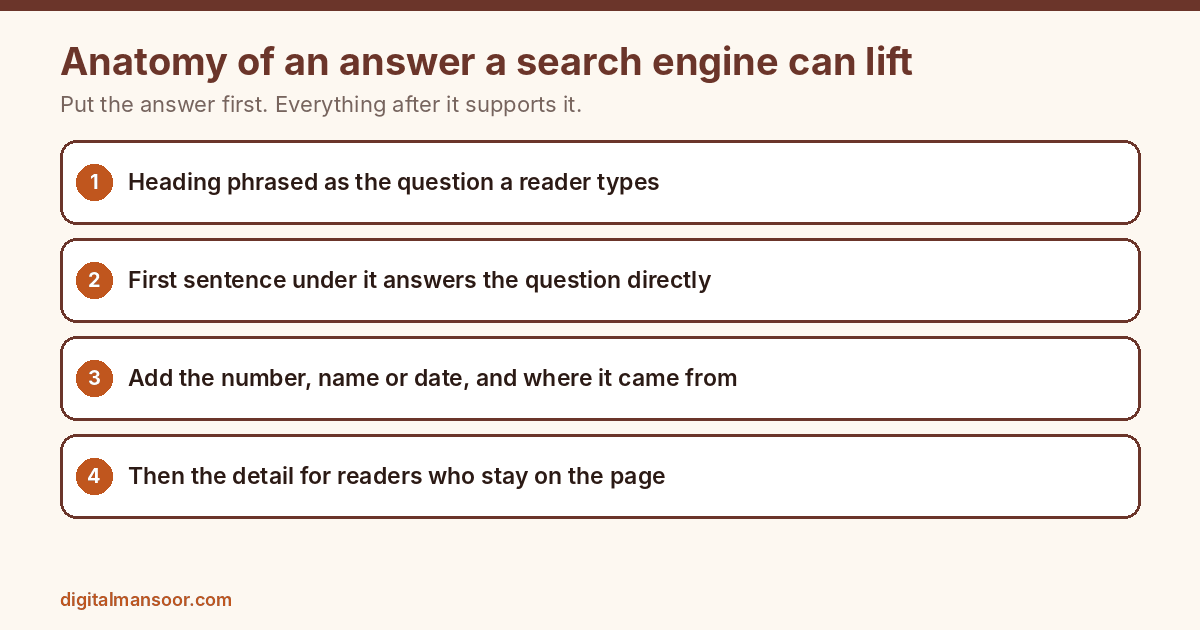
Four-part layout of an answer a search engine can lift
What is a canonical tag?
A canonical tag is a link element in a page’s head that names the preferred URL when several URLs show the same or very similar content. Google treats it as a hint, not a command, and weighs it alongside redirects and sitemap signals.
The tag is only valid in the head, and Google recommends absolute URLs…
The first paragraph can stand alone if a search engine lifts it. Everything after it earns the click for readers who want more.
Notice what the block leaves out: any opening line that delays the answer, like “great question” or “in this section we will”. Those push the answer down and give an extractor nothing useful to grab. They also read badly to humans, which is the more reliable test.
Keep each section about one question. A section that answers three questions gives a search engine three candidates and no clear winner. A page with eight tight sections, each with its own question heading, gives it eight chances without any one section competing against another on the same page.
Length is the question I get most and the one I can’t answer from a source. Google publishes no word count for snippets. Treat any article that tells you “exactly 42 words” as folklore, and check what the winning result for your own query looks like instead.
Question research that doesn’t produce forty thin pages
The easy way to ruin AEO is to turn it into volume. Pull every question from a tool, publish one page for each, and call it coverage. Google’s spam policies name scaled content abuse, meaning many pages generated primarily to rank without adding value, whether a person or a machine produced them.
A better route has three steps.
Open Search Console and filter queries that start with who, what, when, where, why or how. Sort by impressions. Questions where you already sit between positions 4 and 15 are your cheapest wins, because Google already considers the page relevant.
Add the questions from the People Also Ask box on your two or three most important result pages. Those show you how Google groups related questions.
Add what your sales or support team hears. Site search logs work too. These are the questions no keyword tool will ever show you.
Then place each question on the page where it belongs. Most of them become sections inside an existing guide, not new URLs. That also keeps you out of keyword cannibalization trouble, since you’re strengthening one page instead of spawning five that compete.
Google’s documentation also notes that featured snippets can appear inside a People Also Ask group. So one good section can serve two surfaces.
What to skip
Skip the FAQ schema purchase. For years AEO guides told you to wrap questions in FAQPage markup to win rich results. Google’s FAQ documentation now says the feature stopped appearing in Google Search from May 7, 2026, and the documentation itself was removed in June 2026.
Some vendor guides still recommend it as an AEO step. Whether the markup helps other AI tools is untested, and I wouldn’t pay for it on that hope.
Skip the voice-search budget line. Voice assistants are the hardest of these surfaces to measure, and I found no solid public data I’d stake a plan on. If your featured snippet content is good, you’ve done what’s possible there.
Some vendors say voice assistants read snippets aloud. That’s plausible, but it’s a vendor claim, so I’m not building on it.
Skip the thirty-question FAQ block at the bottom of every page. It reads like padding because it is padding.
When AEO is the wrong priority
Some pages should not chase answer boxes. If your product page, pricing page or service page targets a buying query, an answer box rarely exists for it, and rewriting the page as Q&A can weaken the sales copy. AEO fits informational content: guides, glossary entries, comparison explainers and support articles.
It also fits poorly when your site has a deeper problem. A page that Google hasn’t indexed can’t win a snippet. A page buried on page four has nothing to promote. Fix crawling and ranking first, then work on the answer layer, because the answer layer only multiplies what is already there.
And be wary of the opposite error, where a team rewrites every article into a stack of question headings in the name of AEO. Readers who came for a narrative explanation get a wall of fragments. Use question headings where a reader would plausibly ask that question, and leave the rest of the piece alone.
Measuring a narrow target
This is where the narrow definition pays off. Most major rank trackers flag which keywords currently show a featured snippet and who owns it. Build a list of 30 to 50 target questions, record the current owner of each snippet, and check again after Google has recrawled your updated pages. The URL Inspection tool in Search Console shows the last crawl date for a page, which tells you when a recheck is fair.
Don’t expect clean attribution. Search Console reports clicks and impressions by query and page, but a snippet win is something you spot by looking at the results page yourself. Keep a simple sheet: question, target page, snippet format, current owner, date checked. It takes ten minutes a month and it’s more honest than any dashboard that claims to score your answer readiness.
Quick answers
Is AEO a replacement for SEO?
AEO sits on top of SEO. A page has to be crawlable, indexed and ranking well before an answer box is even possible, so AEO works as a layer of writing discipline over the ordinary job.
Can I force a featured snippet for my page?
Google’s documentation says you cannot mark a page to become one, and it lists no criteria. You can make the page easier to choose, or block snippets if you don’t want one.
How do I stop my page from being used as a snippet?
Use nosnippet to block all snippets, or max-snippet to block featured snippets while keeping regular ones. Google says nosnippet is the only guaranteed option, since shorter max-snippet values make a featured snippet less likely without promising it stops.
Your next hour
Pick five questions your best customers ask before they buy. Search each one and write down who owns the snippet and what format it takes.
Then open your own page for each question and ask a plain thing: does the first sentence under the heading answer it? If not, rewrite that one sentence first. If you want a second opinion on where to start, my AEO consulting page explains how I scope this work.
Leave a Reply