
Last updated on November 16th, 2026 at 01:13 pm
Google’s spam policy defines scaled content abuse as many pages generated for the primary purpose of manipulating rankings, and it applies “no matter how it’s created”. That sentence is the whole problem for programmatic SEO. The method (a template plus a dataset equals thousands of pages) is allowed. The outcome, thousands of near-identical pages that exist only to catch searches, is what gets sites hit.
I’ll explain what programmatic SEO is, what the evidence says about where it works, how sites get into trouble, and how to run a small pilot before you commit to a large build. One warning first: the case studies you’ve seen, including the famous ones, rest on estimated traffic from third-party tools. Read every figure in this space with that in mind.
What programmatic SEO actually is
You build one page template, connect it to a structured dataset, and publish a page for each row. A mortgage site might generate a page per city. A SaaS company might generate a page for each pair of apps it connects. A jobs site might generate a page per role and location.
The idea only works when each row has real search demand and the page can say something useful about that row. Both conditions matter. A page for a combination nobody searches for earns nothing, and a page for a searched combination with no unique information earns a spam flag.
The Zapier problem
Every guide on this topic leans on Zapier. Look at what the numbers say before you copy the model.
Third-party estimates of Zapier’s organic traffic disagree wildly. One upgrowth analysis, using a Semrush estimate from September 2026, puts it near 1.8 million monthly organic visits. Other pages quote 2.3 million, 5.8 million or 16 million. I can’t tell you which is right, because Zapier doesn’t publish the figure and each tool counts differently.
The more useful finding is where the traffic lands. The same upgrowth analysis says about 88% of Zapier’s estimated organic visits go to its blog, with the app and app-to-app pages supporting the rest. An older Ahrefs study put the blog’s share at 67.5%. The exact split differs, but both say the blog does most of the work.
Ahrefs also found a programmatic Zapier landing page, for a three-app combination, with no organic traffic at all. Even the best-known example publishes pages that earn nothing. Zapier’s sitemaps listed 9,724 app pages and 140,272 app-to-app pages in upgrowth’s September 2026 check. I can’t tell you how many of those pages draw visitors, because no public source breaks it down.
Zapier also has something your site likely lacks: a real product with real integrations behind every page. The page describes something that exists. Copying the template without the underlying product copies the risk and none of the value.
What Google says
Google’s spam policies list examples of scaled content abuse. They include using generative AI to create many pages without adding value, scraping feeds or search results to produce content, and stitching together content from different web pages without adding value.
The doorway abuse section covers a nearby pattern: pages made to rank for similar queries that funnel visitors to the same place. The listed examples include city-targeted pages that lead to one page, and substantially similar pages that sit closer to search results than to a clear site hierarchy.
John Mueller commented on a site generating pages from combinations of attributes. According to the TechWyse report of his Bluesky reply, he said programmatic SEO often leads to a site that is spam, borderline spam or low quality. The same report says he did not claim all programmatic work is spam, and it adds that Google’s systems may lose faith in a site after it publishes many weak pages. That comes through a secondary source, so confirm the wording before you quote it.
What happens when it goes wrong
Glenn Gabe documented several sites hit by Google’s August 2026 spam update. One combined programmatic and AI-generated content in an ultra-sensitive niche. He also noted that spam update effects can spread across a whole domain, similar to a broad core update, not just the weak section.
Search Engine Journal covered a founder whose site was deindexed after a programmatic push. The site had no manual action, and Google removed the pages for poor quality. The founder recovered, but only after removing the pages.
Recovery isn’t quick. A podcast summary of Gabe’s cases mentions one site that began recovering about five months after major fixes. That’s an anecdote, not a rule, and Google gives no recovery schedule.
I’d treat the “80% of programmatic projects fail” statistic you see floating around as unsupported. I found it on a developer blog with no source.
Seven checks before you build
Run these on the idea, before any code.
- Demand per page. Pull keyword volumes for a sample of at least 30 rows from your dataset. If most return zero, the pattern doesn’t have demand.
- Unique data. Does each page contain a fact a searcher can’t get from a generic result? Your own prices, your own measurements, your own listings count. A swapped city name doesn’t.
- Answer quality. Open five sample pages and ask whether a person with that question gets a useful answer within the first screen.
- Standalone value. Would this page exist and help visitors if search engines didn’t? If the honest reason is only rankings, stop.
- Duplication. Compare two pages side by side. If most of the text matches, merge the rows or add differences that matter.
- Maintenance. Who updates the data when it changes? Stale pages signal low care.
- Exit plan. Decide in advance what result would make you remove the pages.
How to run a pilot
Start small, around 50 to 100 pages, picked from the rows with the strongest demand and the richest data. Publish them, link them from a hub page and submit a dedicated sitemap for just that template.
Then watch the Page indexing report in Search Console. If Google indexes most of the pilot and the pages collect impressions within a few weeks, you have a signal. If many land under crawled currently not indexed, Google has seen the pages and chosen not to keep them. That’s feedback on quality, and adding more pages makes it worse.
Don’t scale on impressions alone. Look for clicks and for what visitors do next. A page that attracts visits and bounces them immediately isn’t working.
Scale in steps, not all at once. Add the next batch only after the pilot shows the pages stay indexed and earn traffic. Keep each batch in its own sitemap, so you can see which template or group of rows is in trouble.
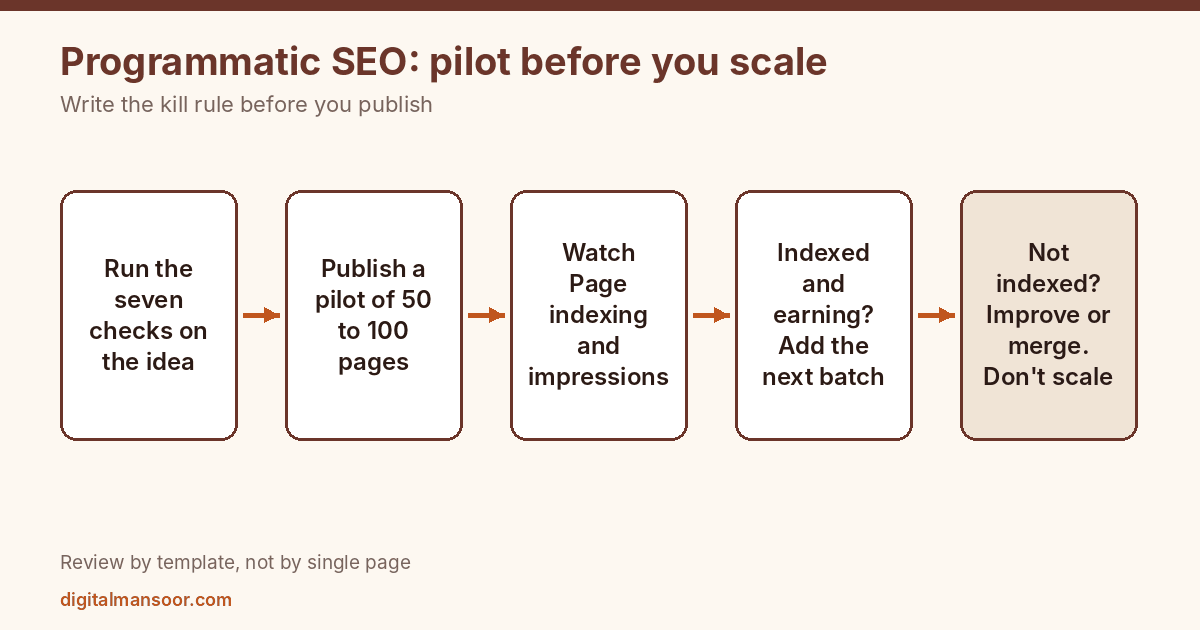
Set a kill rule before you publish
Teams rarely remove pages once they exist, so write the rule down first. Pick a date, such as three months after launch, and a floor for each template. For example: fewer than half of the pilot pages indexed, or fewer than a set number of clicks per page across the group.
If the group misses the floor, you have three options. Improve the data on the pages, merge rows into fewer and richer pages, or remove the template from the index with noindex and remove it from the sitemap. Deleting URLs outright works too, but redirect any page that earned links.
Review by template, not by page. One weak row tells you little, while a whole template under the floor tells you the idea has a problem. Keep the review dates in a shared sheet so the decision doesn’t depend on anyone’s memory or mood.
The same discipline applies after a win. A template that works can still age badly when the underlying data goes stale, so schedule a data refresh and a spot check of ten random pages every quarter.
Technical points that matter
Each page needs a self-referencing canonical, a unique title and a unique H1 built from the row’s real attributes. Link the pages from category hubs, so crawlers reach them through ordinary links and not only through sitemaps.
Use noindex for combinations without demand or data, and keep them out of your sitemap. It’s better to publish 400 good pages than 4,000 where 3,600 are empty.
Check how the template renders when a field is missing. An empty table or a sentence with a blank where the data should sit is the fastest way to produce a thin page. Decide in advance whether a row with missing data publishes at all.
An example of the risk, with Indian service sites
City pages are the classic trap for local service firms in India. A chartered accountant or a digital agency copies one page across 300 cities and swaps the city name. That is exactly the shape Google’s doorway abuse examples describe, and it adds nothing for a reader in Pune that the Delhi page doesn’t already give.
A version that works needs something specific per city. Local fee ranges you actually charge, local regulations, named offices, real client types or answers to questions people in that city ask. If you can’t supply that for a city, don’t publish the page. This example is illustrative, not a documented case.
When to skip it
Skip programmatic SEO if you don’t own a dataset, if your product has no natural pattern of repeatable pages, or if you’re planning to fill templates with AI-written text to save time. In those cases, a smaller set of hand-built pages around real questions will perform better and carry less risk.
It also doesn’t suit a brand new site with no links. Weak sites with thousands of weak pages give Google little reason to trust any of them.
Template pages often compete with each other, so read the keyword cannibalization guide before you scale. Pages that sit alone with no supporting content rarely hold up, which the topical authority guide explains. Crawl and indexing checks for a pilot are part of my technical SEO service. Catalogue sites face a similar risk with filters, covered in the ecommerce SEO checklist.
Quick answers
Is programmatic SEO against Google’s rules?
The method isn’t banned. Pages created mainly to manipulate rankings are, regardless of how they were made.
How many pages should a pilot have?
There is no official number. I suggest 50 to 100, enough to read the indexing and traffic signals without much exposure.
Can AI write the pages?
Google’s policy covers content made with generative AI when it adds no value. If the data and structure give each page real value and a person reviews samples, the tool matters less than the result.
What if pages are indexed but get no traffic?
Check whether the keyword has demand, whether the page answers the query and whether your internal links reach it. If none of that helps, remove or merge the page.
Where to start
Pick the one dataset you own that no competitor has. Build ten pages by hand from it before you automate anything. If those ten are worth reading, the template has a chance. For a plan that connects a programmatic build to the rest of your content, see my content strategy SEO consulting page.
Leave a Reply