Last updated on November 16th, 2026 at 01:12 pm
Pew Research Center followed 68,879 Google searches from 900 US adults in March 2025. Only 18% of those searches produced an AI summary. The data is old and American, but it works as a corrective whenever a vendor tells you search has already flipped.
It cuts the other way too: 58% of the people in the panel met at least one AI summary during that month. Most searches had no summary. Most searchers still saw one.
So what is generative engine optimization? GEO is the work of making your pages and your brand easy for AI answer systems to find and cite. Those systems include ChatGPT search, Perplexity, Gemini, and Google’s AI Overviews and AI Mode. A win means a cited link or a named recommendation inside the answer the model writes, with no ranking position involved.
That definition sounds clean. The practice is messier, because the biggest search engine on the planet says GEO is mostly SEO under a new name. Both claims hold up better than you’d expect, and the gap between them is where your budget should go.
Where the term came from
The label comes from a 2023 research paper, GEO: Generative Engine Optimization, by Pranjal Aggarwal and colleagues, later published at KDD 2024. The authors built a benchmark of 10,000 queries and tested different ways of rewriting content to see which edits made a source more visible in generated answers.
Their headline number: visibility improved by up to 40%. Citations and quotations from other sources, plus statistics, helped most. On Perplexity.ai the gain reached 37%. The authors also reported that what worked varied by domain, so a tactic that helped a history answer did little for a legal one.
Read that result with a squint. It comes from one benchmark, using the authors’ own visibility measure, on systems that have changed since 2023. I did not find an independent replication while researching this piece. Treat 40% as a ceiling from a lab, not a forecast for your site.
Still, the direction makes sense. A page that names its sources and puts numbers on its claims gives a model something concrete to lift. A page full of adjectives gives it nothing.
How an AI answer picks its sources
Most of these tools retrieve first and write second. The system pulls documents that look relevant, then drafts an answer grounded in them. The technical name is retrieval-augmented generation, and Google’s own AI optimization guide describes it in those terms.
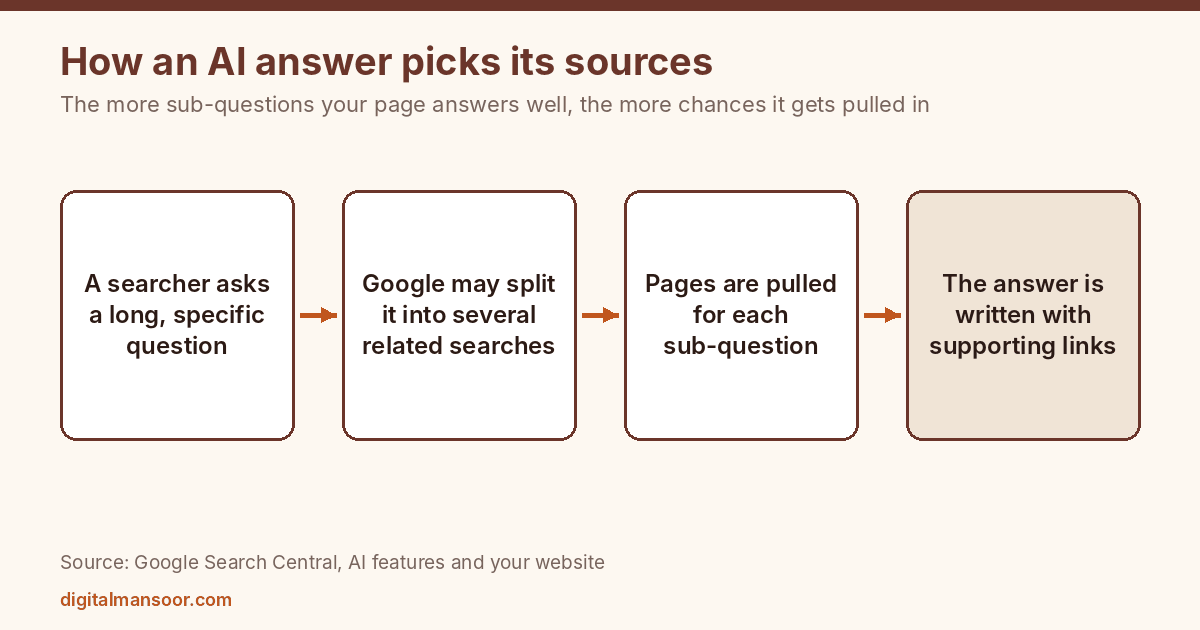
That guide also describes query fan-out. One question gets split into several narrower searches that run at the same time, and the answer stitches the results together. Google’s AI features documentation says both AI Overviews and AI Mode may use it.
Pew’s data adds one more detail: 88% of the summaries it captured cited three or more sources. So an answer rarely has a single winner, which means a mid-ranked page with the right paragraph can still get in.
Fan-out has a practical consequence. You can get cited for a sub-question you never targeted, because one paragraph on your page answered it better than anyone else’s page did. A narrow, well-built section can beat a broad page.
It also has a trap. Google says that creating separate content for every fan-out query violates its scaled content abuse policy. So the lazy version of GEO, where you publish fifty thin pages that each answer one imagined sub-question, is the version Google has already named as spam.
Google’s position: this is still SEO
Here is the part vendors skip. Google’s AI features documentation says a page must be indexed and eligible to show a snippet before it can appear as a supporting link in AI Overviews or AI Mode. It lists no additional requirements. You don’t need special schema, and you don’t need new machine-readable or AI-specific text files.
The optimization guide goes further. From Google’s view, answer engine optimization and GEO are still SEO, and it points readers to its existing advice on judging third-party SEO claims. The guide pushes what it calls non-commodity content: pages that offer something a competitor’s page can’t copy by rewording the same facts.
I think Google is right about the mechanics on its own products and incomplete about everything else. Google speaks for Google. ChatGPT, Perplexity and the rest run their own crawlers and their own retrieval, and none of them publishes a ranking factor list. A document from Mountain View can’t tell you why Perplexity cites a forum thread over your guide.
That is the honest case for treating GEO as its own line of work. Not because the craft is different, but because three things sit outside what Google controls: which bots can reach you, what other sites say about you, and how you measure results across tools.
Check which bots can reach you
Start with the boring part. If an AI search tool can’t fetch your page, the rest of this list is wasted effort. OpenAI documents three separate crawlers with different jobs.
| Bot | What it does | What blocking it does |
|---|---|---|
| OAI-SearchBot | Finds pages for ChatGPT search | Your site won’t be shown in ChatGPT search answers, though it can still appear as a navigational link. Changes take about 24 hours. |
| GPTBot | Collects content that may be used for training | Opts your content out of training use |
| ChatGPT-User | Fetches a page when a person asks ChatGPT to | OpenAI notes that robots.txt rules may not apply to these user-initiated fetches |
Because OpenAI lists them as separate bots, a site can set rules for each one. Some publishers want out of training but still want a place in ChatGPT’s search answers. A blanket block on everything with “GPT” in the name removes both. Run your file through a robots.txt checker and read the result line by line before you assume anything.
What to do, in order of payoff
Check that the pages you want cited are indexed and carry no nosnippet directive, using the URL Inspection tool in Search Console for a handful of your best pages. Google’s documentation names both as the entry ticket. Many sites fail here and then go shopping for AI visibility tools.
An AI system lifts a chunk, not your whole page. Put the answer in the first sentence under a heading, then add the number and where it came from. Pew found the median AI summary ran 67 words, which leaves little room.
A page that takes 400 words to reach its answer gives the model less to quote, because by the time the useful sentence arrives the surrounding text has already padded it with context the model will never use. That last point is my inference from the Pew figure, not something Pew tested.
Original data, a test you ran, a screenshot of your own account, a price you actually paid. This is the practical meaning of non-commodity content, and it lines up with the GEO paper’s finding that statistics and quotations help. A generic “what is X” page competes with every other generic page. A page with a number nobody else has competes with nothing.
Pew’s data shows Wikipedia, YouTube and Reddit together supplied 15% of the sources in AI summaries. I’d read that as a reason to care what gets said about you off your own site: review platforms, community threads, trade press, your founder’s own profile. You can’t buy this. You earn it by being worth mentioning, and by answering questions in the places where people ask them.
Keep the right bots allowed (see the table above), and decide on training and search separately.
Google counts traffic from AI Overviews and AI Mode in the Web performance report in Search Console, mixed in with ordinary clicks.
That means you can’t split it out cleanly there. For the other tools, build a fixed list of 20 to 30 questions your buyers ask. Run them monthly in each tool, log the date, and record whether you were cited, mentioned or absent. Expect the answers to change between runs, so one test is a sample and not a verdict.
What GEO will not do for you
It won’t bring the clicks back. Pew found that people clicked a traditional result link in 8% of visits when an AI summary appeared, against 15% when it didn’t. Clicks on a link inside the summary itself happened in 1% of visits. And 26% of visits with a summary ended right after the search page, against 16% without one.
So if your business lives on informational traffic, a citation is closer to a billboard than a visit. Brand exposure has value, but it is hard to measure and easy to oversell. Anyone who promises a traffic recovery from being cited has not looked at those numbers.
Shortcuts fail too. Google’s AI features documentation says you need no new machine-readable or AI text files, and John Mueller compared llms.txt to the keywords meta tag in 2025. I’ll cover that file properly in its own post. For now, don’t pay anyone to install it as your GEO strategy.
And watch the guarantee sellers. No engine publishes a ranking factor list, so “guaranteed ChatGPT rankings” is a sales line, not a service.
Who should care this quarter
Pew found that short searches rarely triggered a summary: 8% of one or two word searches did, against 53% of searches with ten or more words. People who research a category by typing full questions are the ones meeting AI answers most often. If your buyers do that (software evaluation, professional services, anything with a long comparison phase), GEO deserves a slice of your content budget now.
If your traffic comes mostly from short, navigational or transactional searches, you can start with the basics above and wait for firmer data. If you want help scoping this for a specific site, my GEO consulting page lays out how I approach it.
Quick answers
Is GEO the same as answer engine optimization?
They overlap heavily. AEO usually refers to winning direct answers, featured snippets, while GEO targets generated answers from AI systems. I cover the first on my AEO consulting page.
Do I need a separate GEO team?
No evidence says you do. Google’s guidance treats this as the same work as SEO, and most of the checklist above sits inside a normal SEO workflow.
Does schema markup help me get cited?
Google says no special schema is needed for its AI features. Whether markup helps other AI tools is unproven, so don’t pay extra for it on that promise.
Your first week
Open your robots.txt and confirm OAI-SearchBot is not blocked. Then pick 10 questions your best customers asked before they bought, run each one through ChatGPT, Perplexity and Google AI Mode, and write down who gets cited. That sheet will tell you more about your GEO position than any audit report.
Leave a Reply