Last updated on November 16th, 2026 at 01:12 pm
Two large studies asked the same question about Google AI Overviews: how many cited pages also rank in the organic top 10? BrightEdge reported about 17%. Ahrefs reported about 38%. Both can be accurate, and the gap between them is the most useful thing to understand before you start any AI Overview optimization work.
The short version: Google requires very little, ranking alone doesn’t predict inclusion, and the tactics that help are mostly about being the clearest source on a narrow part of a topic. The rest of this piece unpacks each of those points and flags where the evidence is thin.
What Google says you need
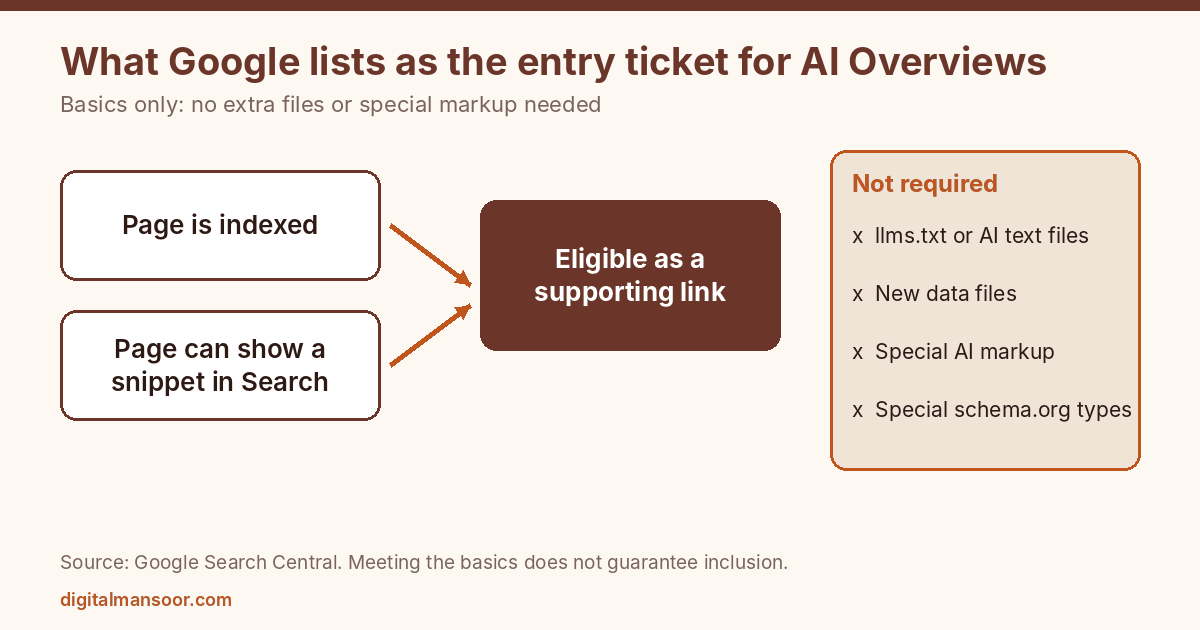
Google’s AI features documentation is short on conditions. To appear as a supporting link in AI Overviews or AI Mode, your page has to be indexed and able to show a snippet in Search. The page states there are no additional technical requirements. It also says meeting the basics doesn’t guarantee Google will crawl, index or serve your content.
The same page rules out several things sold as shortcuts. You don’t need new machine-readable files, AI text files or markup. You don’t need special schema.org structured data either, and any structured data you do use should match the visible text on the page.
It adds one fact that changes expectations: AI Overviews appear only when Google’s systems decide they add value beyond classic search, so they often don’t trigger. If you’re measuring your page against a keyword where no overview appears, you have nothing to win.
Pew Research Center gives a sense of how often that happens, with the caveat that its data is from US adults in March 2025. Pew found that 18% of the searches it tracked produced an AI summary. Short searches rarely did: 8% of one or two word searches, against 53% of searches with ten or more words. Long, specific questions are where overviews live.
Why rank alone doesn’t predict inclusion
Take the two overlap studies seriously, and then read how they were built.
Ahrefs analysed 863,000 keywords and 4 million AI Overview URLs and found that 37.9% of cited URLs also appeared in the first ten blocks of the regular results. Another 31.2% sat at positions 11 to 100, and 31.0% didn’t rank in the top 100 at all. Ahrefs said the figure was roughly 76% in its July 2025 study, and that Gemini 3 began powering AI Overviews in January 2026. It collected the data from Brand Radar, its own AI visibility tool, so treat the numbers as a vendor’s measurement.
Search Engine Journal’s coverage adds that a separate BrightEdge analysis, published in February 2026, found only about 17% overlap using a different method and dataset. The two studies define overlap differently and sample different queries, so they can’t both be read as a universal rate.
What survives both studies is a narrower conclusion. Sitting in the top 10 is a weaker predictor of being cited than it used to be, and a fair share of cited pages rank nowhere near the top for the exact query. Google’s fan-out description explains part of it. A page can get pulled in for a sub-question the main query never spelled out.
So don’t plan around a number. Treat page-one ranking as a useful base, one that gets you crawled and trusted, and treat citation as a separate prize you have to earn at the passage level.
Design pages for the questions behind the question
Google says both AI Overviews and AI Mode may run multiple related searches across subtopics and data sources while a response is being built, and that the systems find additional supporting pages along the way. That is query fan-out in practice.
A page about, say, choosing a CRM for a 20-person company might have to answer one question about pricing models, another about migration time and a third about data export. If your page handles all three in tight, clearly headed sections, it has three chances to be the best answer. If it covers them in two vague paragraphs, it has none.
So audit your key pages for subtopic coverage. Search your target question, read the related searches and People Also Ask entries, and note which sub-questions a buyer would ask next. Then check whether your page answers each one in its own section.
Resist the temptation to publish a separate page for every sub-question. Google’s AI optimization guide says creating separate content for each fan-out query violates its scaled content abuse policy. Depth inside one strong page is safer, and it keeps the signals concentrated.
Be the source a summary can’t get elsewhere
Google’s guide pushes what it calls non-commodity content, meaning pages that offer something other pages can’t reproduce by rewording the same facts. In practice it comes down to a few concrete things.
Original numbers. If you ran a test, collected prices or surveyed customers, publish the result with the method and the date. A summary that wants a number has nowhere else to get yours.
First-hand detail. A screenshot from your own account, a process you followed step by step, a mistake you made and corrected. A competitor can’t paraphrase these from the top ten results, because they don’t appear there.
Named, linked sources for any claim that isn’t yours. The 2023 GEO research paper found that citations, quotations and statistics improved visibility in its benchmark, with the usual caveat that it was a lab study on the authors’ own test set. The practical reading is simple: a paragraph that shows its evidence gives a model less reason to look elsewhere.
Clear answer-first writing under each heading, because a summary lifts passages, not pages. I covered the mechanics in my post on what answer engine optimization is, and the same section pattern applies here.
Video and off-site presence
Ahrefs’ study found something awkward for text-only publishers. Among cited pages that didn’t rank in the top 100 for the same keyword, 18.2% were YouTube URLs, and YouTube accounted for 5.6% of all AI Overview URLs in the dataset. Ahrefs also says its Brand Radar data shows YouTube as the most-cited domain in AI Overviews.
Again, that is one vendor’s tool and one sample. But Pew’s separate finding that Wikipedia, YouTube and Reddit made up 15% of AI summary sources points in a similar direction. If your buyers ask how-to questions, a short video that demonstrates the answer may earn a citation your article won’t. Only invest if you can make video you’d be proud of, and don’t copy your article onto the screen.
Preferred sources
Separately from citations, Google’s preferred sources documentation says a user’s selected sites can also appear in AI Mode and AI Overviews, marked with a preferred badge. To qualify, your site needs to be included in Search generative AI features in Search Console, and only domain-level and subdomain-level sites count. The page was last updated on September 18, 2026. I wrote up the setup steps in my preferred source guide.
Controlling what Google shows
You may decide you don’t want a page used. Google’s documentation lists nosnippet, data-nosnippet, max-snippet and noindex as ways to limit what appears from a page, and says these preview controls also apply in AI features. If content keeps appearing after you add one, confirm Googlebot can see the control with the URL Inspection tool, then allow time for recrawling, which Google says can take days to months.
The Google-Extended token is a different control. Google’s page says it limits AI training and grounding in some of Google’s other systems, and it links out for the details instead of explaining them. Read that documentation before you assume what it blocks.
How to measure it
Traffic from AI Overviews and AI Mode counts inside the Web search type in your Search Console Performance report, mixed with everything else. Google doesn’t give you a separate line for it, and its documentation suggests tracking conversions and time on site through a tool like Google Analytics.
So measure by hand. Make a list of 30 questions that match your service, check them monthly in a logged-out browser in your target country, and record whether an overview appears, who is cited, and whether you’re among them. Overviews change over time, so write the date next to every result. A sheet like that will tell you more than any “AI Overview score” a tool invents.
What I’d avoid
Don’t pay for FAQ schema on the promise that it triggers overviews. Google’s AI features page requires no special markup, and the FAQ rich result stopped appearing in Google Search from May 7, 2026.
Don’t mass-produce answer pages. Don’t claim a guaranteed overview slot for any client, and don’t believe anyone who does, because Google’s own documentation says even its basic requirements guarantee nothing.
Where this advice runs out
Three limits are worth stating plainly. First, AI Overviews change. Ahrefs itself notes that the underlying model changed in January 2026, and its overlap figure fell sharply across the same period, so any tactic tied to today’s behaviour has a shelf life. Second, the studies measure citations, not clicks, and Pew’s click data shows that few visits follow a citation inside a summary. Third, nobody outside Google can see the full selection logic, which means every tactic here is an informed bet.
That’s an argument for modest, repeatable work rather than a rebuild. Improve the pages that already earn your revenue, keep a dated log, and revisit the log each quarter.
Quick answers
Do I need to rank in the top 10 to be cited?
The evidence says no. Ahrefs found only 37.9% of cited URLs ranked in the top 10 for the same query, and its remaining citations were split between lower positions and pages outside the top 100. BrightEdge found even less overlap.
Does structured data help?
Google says special structured data isn’t a requirement. Use markup where it matches the visible page content and serves another purpose, such as product or organization information.
Can a small site get cited?
Google’s documentation sets no size limit, only indexing and snippet eligibility. Beyond that, I found no published size threshold I could verify.
A first step
Pick the five pages that matter most to your revenue. For each, search the main question, write down the three follow-up questions a buyer would ask, and check whether your page answers each one under its own heading. Fix the gaps in your strongest page first. If you’d like help prioritising, my AEO consulting page explains how I run this audit.
Leave a Reply